Friday, November 30, 2007

Disappointing Fall Chinook Spawner Run; Coho in trouble too!

Escapement is the term used to describe those salmon which are able to avoid capture by ocean commercial and sport fishers, tribal fishers and in-river sport fishers. For a fishery to be sustainable, spawner escapement must be large enough to produce the fish which will be caught three and four years from now. This year Klamath River Fall Chinook escapement appears to once again be insufficient to produce good future harvests and a sustainable fishery.

Yesterday I ran into one of the biologists who monitor the Chinook and Coho salmon runs in the Klamath River and its main salmon producing tributaries – the Scott, Shasta and Salmon Rivers. I asked him about this year’s spawning runs. Bottom line: the news is both bad and good but mostly bad.

This year the Fall Chinook run in the Klamath River was late. It was also a year when the Pacific Fisheries Management Council (PFMC) - which sets Chinook harvest rates based on long-term data, predictive models and politics – allocated a larger number of salmon for harvest than we have seen in recent years. This allowed the Yurok Tribe – which has rights to about 40% of the allowable harvest – to schedule the first commercial fishing season in nearly a decade. Cal Fish & Game provided a generous allocation to in-river sport fishers. Ocean sport and commercial fishers also enjoyed solid allocations.

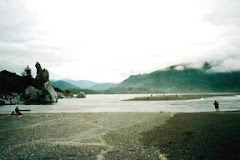
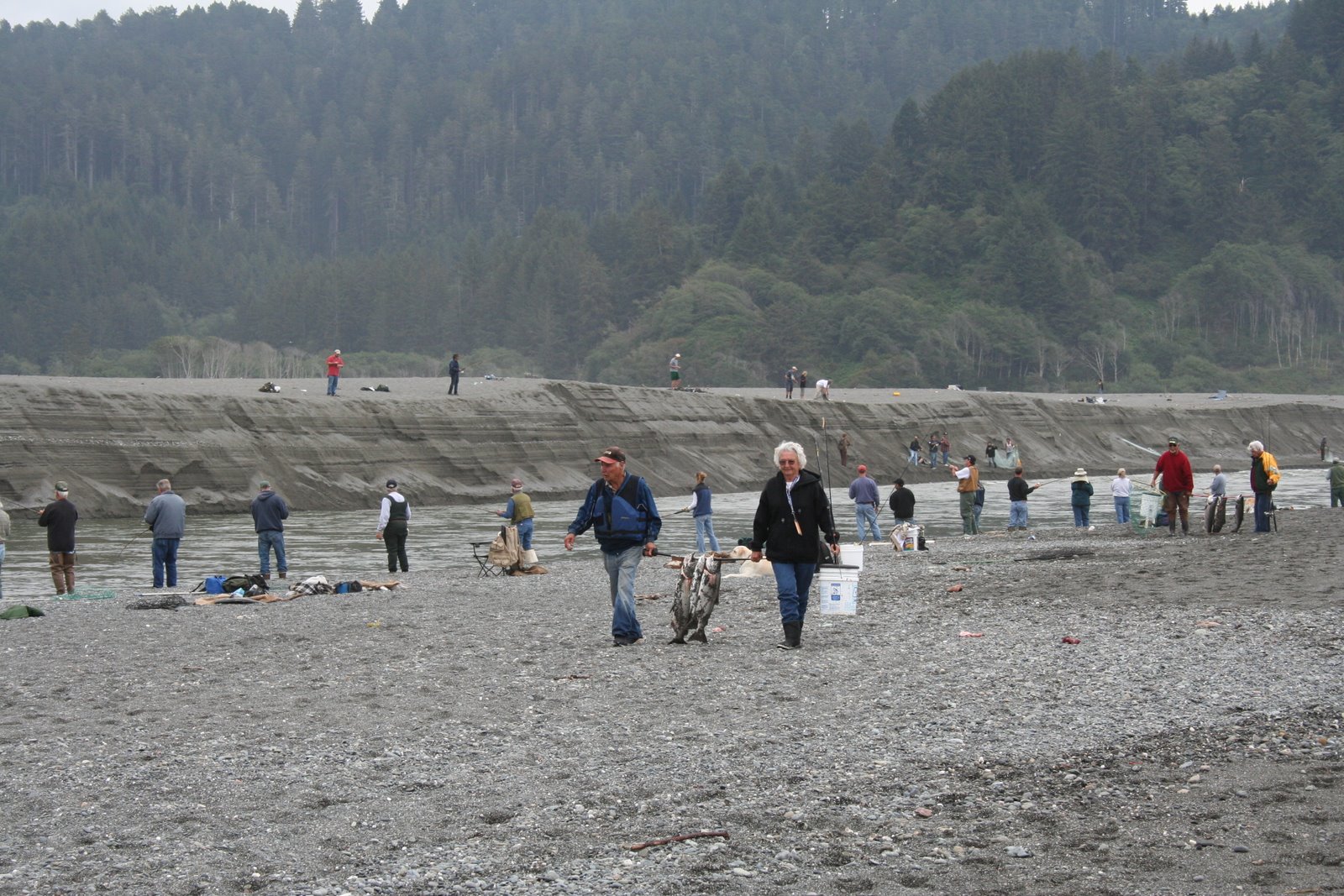
Relatively generous harvest allocations made for lots of happy faces at the mouth of the Klamath this fall. It was great to see Yurok and sport fishers working together at the River’s mouth to make sure everyone had an opportunity. Among the Yurok fishers were several teenagers who fished commercially to finance their college educations. Below are two photos from the height of the harvest at the Mouth. The first shows a sport fishing couple who had caught their daily quota; the second shows tribal fishers at work:


As the Chinook moved up river, however, it became clear that this years spawning run will likely not meet the 35,000 “escapement floor” established by the PFMC. This is not new! With seats for commercial fishermen, tribal interests and state wildlife agencies that favor high sport allocations, the PFMC has often overallocated West Coast Chinook salmon; as a result, the Klamath spawner “floor” is regularly not met. Even when achieved, 35,000 spawners will not produce the maximum number of harvestable salmon. To maximize the Klamath Fall Chinook run the PFMC would have to manage for 41,000 Wild Fall Chinook to escape capture and spawn. (A more complete explanation of Klamath Harvest Allocation by legendary tribal fisheries biologist Ronnie Pierce is available from the Yreka Office of the US Fish and Wildlife Service: 1829 South Oregon Street, Yreka, California 96097, Phone (530) 842-5763, Fax (530) 842-4517 http://www.fws.gov/yreka/outreach.htm).

In one way the lateness of the Fall Chinook run was a blessing. Flows in the Scott and Shasta Rivers this fall have been so low that a normally timed Chinook run would have resulted in spawners not being able to access most of the habitat in these rivers which produce the bulk of the Klamath’s Fall Chinook run. In the Scott a solid rainstorm resulted in the Chinook being able to pass low flow barriers in the Scott Canyon. It is still unclear, however, how many of these Scott River Fall Chinook spawners were able to make it into major spawning creeks. Spawning survey reports should be available by January and will provide a more complete picture. Scott flows as measured at the USGS flow gage have decreased steadily sine the 1970s when groundwater pumping for irrigation began to increase dramatically.

The situation in the Shasta River appears to be even worse. As a result of flaws in the 1928 Shasta River Water Rights Adjudication, landowners along the Shasta River can and do pump as much water as they desire directly from the river. This year the combination of drought and unlimited pumping has resulted in anemic river flows; Fall Chinook were not able to access most prime spawning grounds.

Coho spawners also appear to be in trouble again this year. Unless the latest storms translates into increased stream flow, it appears that Scott River Coho will only be able to access one of the prime spawning creeks in the Scott Valley. Because of its low gradient, side channels, numerous tributaries and wetlands, the Scott River Valley is believed to have once been the stronghold of Coho in the Klamath River Basin. But the wetlands were drained long ago and have not been restored. Now the Scott River produces one significant run of Coho (1,000 or so spawners) about every three years. This is the year that the one-in-three "good" run (called a "cohort" by fish biologists) was expected. If this cohort fails to spawn adequately, Coho could become even more scarce than they are now in the Klamath River Basin.

The State of California is responsible for protecting Scott and Shasta River salmon spawning runs and the Fish & Game Code provides the tools to do the job. Unfortunately, although Governor Schwarzenegger has jumped on the dam removal bandwagon, so far he has not directed those who work for him to help salmon in the Shasta and Scott Rivers. (for more on Cal Fish & Game's failure to protect salmon in the the Shasta and Scott see: http://www.sfgate.com/cgi-bin/article.cgi?f=/c/a/2001/06/22/MN158255.DTL&hw=Glen+Martin+salmon+die&sn=004&sc=432)

Those who want to encourage Governor Schwarzenegger to step up on the Shasta and Scott can contact the governor’s chief adviser on Klamath River issues: Drew Bohan, Deputy Director of the California Resources Agency. Mr. bowen can be reached at 916- 651-8738 or by e-mail: drew.bohan@resources.ca.gov.

_______________________


The photo below is of the Scott River at Serpa Lane near Fort Jones. It was taken this July. In addition to low flow, you can see the tracks of cattle in the bed of the stream. Scott River farmers have received funding to exclude livestock from the Scott River. However, it is still very common there to see livestock or their tracks in the bed of the river as well as in tributary streams. The riparian vegetation visible in this picture is the result of a government funded bank stabilization project.


Wednesday, November 28, 2007

Comment Period Extended - Northcoast-Klamath Draft Action Plan to Control Excessive Sediment

As noted in the November 23rd post on this topic (see below), excessive sediment is a huge problem in almost every Klamath and Northcoast watershed. That's why it is essential that the North Coast Water Quality Board adopt an Action Plan to address excessive sediment that will be effective where past standards and actions have not.

The main culprits in our pervasive sediment problem are related to logging - including the many thousand miles of logging road that receive little to no annual maintenance. Roads which are not maintained are not only chronic sediment sources they also fail sooner or later often resulting in catastrophic sediment torrents that scour streams and fill deep pools with sediment.

By removing the rooted vegetation which holds steep, unstable slopes in place, clearcuts also lead to chronic and catastrophic sediment delivery to streams. And studies by Forest Service researchers have consistently found that the combination of roads and clearcuts increases landsliding rates 50 to 100 times above natural background rates.

The Board has extended the time period for comment until December 14.

The Regional Water Board will now consider Resolution No. R1-2007-0095 at its January 17, 2008, meeting in Santa Rosa. The Resolution directs staff to execute the sediment control tasks described in the Work Plan. Also during the January Board Meeting, staff will present a summary of written comments received and the public will have another opportunity to give oral comments.

The Work Plan to Control Excess Sediment in Sediment-Impaired Watersheds (the Work Plan) is available for public review at http://www.waterboards.ca.gov/northcoast/programs/basinplan/sediment_workplan.html .

Those who comment should insist that the Waterboard:
1. Require that timber companies, the Forest Service and other large landowners conduct annual and post-major-storm road inspections and fix the road drainage and road failure problems these inspections uncover.
2. Prohibit clearcutting on those landforms - including steep slopes, inner gorges and earthflows - which experience and research indicate are likely to produce landslides during major storms if they are clearcut. Lands with the potential to generate large landslides which deliver sediment to streams should be protected in the same ways that we protect streamside riparian areas.

If you have questions or comments on the Work Plan, contact Rebecca Fitzgerald of the Waterboard's staff: 707-576-2650 or rfitzgerald@waterboards.ca.gov.

Sunday, November 25, 2007

Scott River Groundwater Study Plan Politics

Next to the PacifiCorp’s dams, the greatest impediment to restoring salmon, steelhead and a healthy Klamath River Basin may be the progressive dewatering of the Scott River. Unregulated groundwater pumping in the Scott Valley bottoms is likely directly connected to the steady decrease in Scott River flows (check here for a peer review study on this topic due out soon). Groundwater pumping in Scott Valley has increased dramatically with 99 irrigation pumps in 1976 and 228 in 2006. Irrigation pumps generally pump between 100 and 1,000 gallons per minute. Groundwater pumping now accounts for more than half of irrigation in the Scott River Basin.

The North Coast Water Board suspects that groundwater pumping is an important factor in low flows which are directly related to river water temperatures that are out of compliance with established water quality standards and which, in the Scott River, are much too warm to support salmon and other cold water fishes.

For this reason, the Water Board has provided funding to Siskiyou County – which has first jurisdiction over groundwater pumping – to complete a groundwater study designed to determine the impact of the pumping on river water temperature. But the draft study plan which has been prepared in response will unnecessarily delay finding the answer and is loaded with many other study objectives that are not necessary to determine the impact of pumping on river water temperature.

Klamath River restoration advocates are urging a more focused study that will provide an answer soon – before Chinook salmon are extirpated from most of the watershed as a result of dewatering and high water temperatures.

The Scott River Watershed Council – which along with Siskiyou County has resisted dealing with groundwater pumping impacts – has scheduled a meeting to get input on the groundwater study plan. Here are the details:

Scott River Watershed Council Meeting

November 27, 2007 @ 7:00 p.m.

Fort Jones Community Center

Topic: Scott Valley Groundwater Study Plan

Public Comment Encouraged


The Scott River Groundwater Study Plan is available as a 2 Mb .pdf document at the following address: http://groundwater.ucdavis.edu/ScottValley.htm


KlamBlog encourages those who desire a healthy Scott and Klamath River to attend the meeting and to contact the Northcoast Water Board which is funding the study. Please make the following points:

· The salmon can’t wait for a long-term groundwater study and such a study is not needed to provide the information which the Northcoast Waterboard needs to determine the impact of groundwater pumping on Scott River water temperature.

· The study must be narrowly focused on the information the Waterboard – which is providing 100% of the funding for the study – needs. If Siskiyou County wants additional information, they should seek it in a separate study and not delay addressing the problems that must be addressed to restore salmon and the Scott River.

· If Siskiyou County refuses to focus the study and shorten it to a reasonable amount of time, the Northcoast Waterboard should take back the funding and do the study themselves.


Send comments on the Scott River groundwater Study Plan to:

RKlamt@waterboards.ca.gov

BMcFadin@waterboards.ca.gov


Please copy your comments to: unofelice@gmail.com and stay tuned - in the months ahead KlamBlog will review restoration efforts in the Scott River Watershed and attempt to answer the question: Should California Department of Fish & Game give Scott Valley ranchers and farmers a permit to "Take" Coho salmon?

Friday, November 23, 2007

While we wait!

Many Klamath watchers are anxiously awaiting the Klamath "Settlement" Proposal which has been in confidential development for well over a year and which is said to be nearing completion. KlamBlog has commented previously on some of the sticky issues, including the potentially prohibitive cost to taxpayers (see the November 6th post).

This package of proposals is definitely not going to solve all of the Basin’s biggest problems. For example, the water management problems resulting in the progressive dewatering of the Scott River are not “on the table”. And we must retain skepticism about proposals put together under the watchful eye of a Bush Administration Interior Department that has rarely if ever taken sufficient care of the environment. It is also disconcerting that the Klamath Water Users Association and the Karuk Tribe have heavily promoted the Settlement Proposal before key provisions were negotiated.

Whatever is in the final package, however, it will have been the product of many long hours of work by many dedicated people; therefore it will be deserving of close study and careful consideration. But the proposals should not be considered either a unified whole or a done deal that can not be altered. Rather we should consider them just what they are – a set of proposals negotiated by a sub-set of Klamath Basin interests which deserve study and consideration but not blind allegiance.

It is likely that, as these proposals work their way through community meetings and consideration by the state legislatures and Congress, alternatives will be explored and positive improvements in some of the proposals will be made. Above all we are going to have to be careful that proposals do not advantage one group, tribe, industry, interest or geographical area above others and that eager politicians do not run ahead with legislation before the proposals can be thoroughly vetted in our communities and within our organizations. That is what is needed as the circle of consideration expands to include all the Basin’s communities and interests.

What we will not need is more media promotion of what will definitely be a complex and costly set of proposals. Another spin campaign would not help move these proposals forward; on the contrary, spin and hype will likely create unnecessary confusion about the proposals and heightened conflict among Klamath River Basin interests.

When the proposals are finally publicly released, KlamBlog hopes to serve as a forum where a serious conversation about the merits and demerits of the proposals can take place. At that point we will invite submissions from all Klamath River Basin communities and interests.