Thursday, November 28, 2013

Triple Thanksgiving Update: Salmon run prediction wrong again, Bureau of Reclamation doles out KBRA funding, KlamBlog hiatus


This year all those who harvest Klamath River Chinook salmon ought to be particularly thankful. That's because all fisheries – commercial and sport, in-river and ocean, tribal and non-tribal – had plenty of opportunity to catch all the salmon they desire. While final catch numbers are not in, it appears that most fishers did not reach the quota allocated for their industry, tribe or sport.

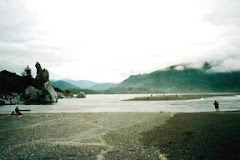
Yurok subsistence fishers at the "Mouth"

The model used to predict Fall Chinook Salmon run size is supposed to get better over time as more years of spawning data are incorporated. Judging from the 2013 pre-season prediction, however, that model still has a long way to go before it will yield accurate estimates of how many Klamath River Fall Chinook are available for commercial, tribal and sport harvest in the Pacific Ocean and Klamath River.

While final totals won't be available until February, preliminary Fall Chinook counts for the Trinity, Klamath, Salmon, Scott and Shasta Rivers indicates that the actual 2013 in-river Fall Chinook Salmon run may be as little as 50% of the pre-season prediction issued by the Pacific Fisheries Management Council (PFMC). That prediction was for a record breaking 273,000 Fall Chinook to enter the river system.

The PFMC's run-size forecast is used to set harvest quotas for ocean commercial, ocean sport, tribal commercial, tribal subsistence and in-river sport fisheries. Harvest quotas in turn are supposed to guarantee that a sufficient number of Klamath Chinook get to spawn in their natal streams. According to the PFMC, 41,000 Chinook must spawn naturally within the Klamath-Trinity River Basin in order to assure maximum production of adult salmon three and four years in the future.

The apparently wide discrepancy between the predicted and actual run size has even fishing advocates like journalist EB Duggan wondering whether the Klamath-Trinity Basin will "be able to make the needed escapement goals.....to sustain the run or are we going to be short?”

If you are confused by all the numbers, estimates, counts and quotas you are not alone. Salmon allocation processes and politics remain a mystery even for many who have a stake in proper salmon management. KlamBlog believes that the best guide to understanding Klamath salmon fisheries management and allocation remains “Understanding Allocation” by legendary Klamath fisheries biologist Ronnie Pierce. 

Ronnie Pierce's report, however, does not explain the very human factors which influence harvest levels and allocation of Klamath-Trinity Fall Chinook Salmon. Prominent among those human factors is the dominance on the PFMC - and on other regional ocean fishing councils established by the Magnuson-Stevens Act - of industrial, tribal, government and sport fishing interests and organizations which have an economic, cultural and bureaucratic stake in maximizing the number of fish available for harvest by humans. Under these circumstances, regional fisheries councils have a tendency to be overly optimistic and to allocate more fish for harvest than ought to be allocated. The result can be missed targets for spawner escapement and depressed or even threatened fish stocks down the line.

The tendency to over-allocate and therefore to over-harvest ocean fish stocks is not, however, only a problem in US ocean waters; the phenomenon is world-wide. For those who want to better understand the dynamics of overfishing and the resulting world-wide decline and loss of ocean fisheries, KlamBlog recommends the web page dedicated to the topic

The Klamath Wildcard

One factor which may account for poor PFMC Klamath Fall Chinook run-size predictions is in-river water conditions during springtime and how those conditions impact the number of juvenile salmon which make it to the ocean in a given year.

Emerging from spawning gravels in the spring, most Klamath-Trinity Chinook Salmon begin their long journey to the sea immediately upon emerging. All those baby salmon must negotiate the Klamath River in order to reach the ocean where they will feed and grow for 3 to 5 years before returning to fresh water to spawn. Due to extremely bad water quality in the mainstem Klamath River, however, a number of those young salmon succumb to fish diseases; dying before they can reach the ocean.

Klamath River fish disease investigations have documented that most Klamath River juvenile salmon are disease infected by the time they reach the lower river. How many young salmon die before reaching the ocean, however, depends on how bad Klamath water quality is during spring; that, in turn, is a function of flow.

When spring flows are low, most juvenile Klamath salmoinids are infected with 
fish diseases; Trinity River juvenile salmonids had a low infection rate in 2001

In years when there is abundant snowpack and/or late and persistent spring storms, spring flows in the Klamath and its tributaries are higher and the chronically poor water quality in the Klamath, Scott and Shasta Rivers is ameliorated. During these “good years” many more juvenile salmon make it to the ocean and, therefore, more salmon return to the Klamath-Trinity River Basin three and four years later.

In essence, Klamath-Trinity Chinook Salmon production is a gamble, dependent on notoriously fickle snow pack, spring storms and resulting stream flow conditions. It is likely that the variability of spring flows – and the resulting variability in water quality conditions year-to-year - explains why Chinook Salmon runs in the Klamath-Trinity River Basin are extremely variable as well as unpredictable. Run-size estimates displayed below demonstrate the huge variability in the Klamath-Trinity Fall Chinook run over time.

Years when few adult spawners return to Klamath streams correlate with low 
flow, poor water quality and high juvenile disease three and four years earlier 

In search of certainty

Just as agricultural producers seeks “certainty” in the water supply available to them, fishers and the fishing industry would like greater certainty (that is, less variation) in how many Fall Chinook Salmon they will be able to catch each year. Greater certainty will not come, however, in relation to snowpack and spring storms. In fact, if climate change predictions for the Klamath River Basin prove accurate, snow pack will be generally lower but even more variable than at present. Spring storms will also remain unpredictable.

There is, therefore, only one way to provide greater salmon run size predictability – and therefore greater stability - for those dependent on Klamath-Trinity Basin Chinook Salmon. If water quality improves, the rate at which juvenile salmon descending the Shasta, Scott and Klamath Rivers will become disease infected and die will go down no matter the level of the snowpack or how many storms come in spring.

Taking down PacifiCorp's Klamath River dams will help improve Klamath River water quality somewhat. But the main source of the Klamath River's poor waster quality is agriculture in the Upper Basin and in the Shasta and Scott River Basins. Unfortunately, prospects for cleaning-up agricultural pollution in those areas are not good.

We have had agricultural pollution clean-up plans in place in the Shasta, Scott and Upper Basin for over six years; but water quality has not improved significantly in those areas. KlamBlog believes the main reason we have not seen significant improvement in water quality in spite of many millions of taxpayer dollars invested in agricultural operations for "conservation" and "restoration" is the reticence of water quality officials in Oregon and California to require riparian protection and to effectively regulate polluted agricultural wastewater discharges. 

State bureaucrats will write plenty of clean-up plans which the EPA will review and approve; but until those bureaucrats summon the will to effectively regulate agricultural operations, water quality will not improve.

Unpacking the reasons efforts to regulate agricultural pollution in the Klamath River Basin have been so spectacularly ineffective is a complex topic and must await a future post. Stay tuned!

BOR doles out KBRA funding

It's official: the United States Bureau of Reclamation has declared that the KBRA and KHSA were “entered into by the Department of Interior on February 18, 2010.” The announcement came in an obscure document dated November 15, 2013. Solicitation Number R14SS98002 announces that Reclamation “intends to negotiate a Firm Fixed Price, Single Source Purchase Order, with Klamath Water and Power Agency (KWAPA), 735 Commercial Street, Klamath Falls, OR 97601-6243.” According to the solicitation document “the proposed contract action is for Reclamation's participation and obligations under two existing agreements with bearing on the acquisition of Federal power,” i.e. the KHSA and KBRA.

Reclamation's declaration may come as a surprise to those who believe propaganda issuing from KBRA/KHSA promoters. For almost three years, these promoters have been telling us that the feds could not commit to the Klamath Dam and Water Deals unless and until Congress endorses and funds them. KlamBlog has long insisted that the KBRA and KHSA are not only being implemented by the feds but that the deals are themselves creations of the Interior Department which reflect federal priorities rather than the will of those whom are called "stakeholders".

We now have it from the horses mouth (so to speak).

What is certain in these two deals is federal priorities - including taking care of Reclamation's own irrigators whom KlamBlog has dubbed the Irrigation Elite because of the many benefits - and the distinct competitive advantage – bestowed upon them by Reclamation with funding from US taxpayers. 

What remains uncertain in the KBRA and KHSA is benefits to tribes and the environment. Those benefits are sometimes wholly rhetorical and where they are real they depend on special funding authorized by Congress and not on Reclamation's regular funding which is apparently reserved via sole source contracts for the Irrigation Elite.

In KlamBlog's view that proves the wisdom of the admonishment: If you want to know what is really going on with American Government, just follow the money.

KlamBlog hiatus

KlamBlog is going on vacation for a couple of months; look for new posts coming your way in February. Until then, have a peaceful and thankful holiday season and remember to trust but verify!

Sunday, October 6, 2013

Greed trumps science - TID's plan to mine groundwater in the Klamath River Basin

Adoption of a Groundwater Management Plan by the Tulelake Irrigation District (TID) this past April has not been reported in the press...but it should have been. The Plan covers the California portion of the Lower Lost River Basin within the Bureau of Reclamation's Klamath Project. In spite of evidence that the deep groundwater aquifer is being depleted, the Tulelake Irrigation District's plan is to
          "enable the District, individual landowners, and their regional neighbors to continue use of local groundwater as a supplemental water supply during years of surface water shortages."

Tulelake Irrigation District (TID) is controlled by fewer than 10 growers who, by virtual of their wealth and political power, dominate both the District and the Klamath Water Users Association. These growers have been successful for over a decade in preventing their "neighbors" from selling legal and contractual rights to Klamath River water so that the rights can be retired and demand for water diverted from the Klamath River can be brought into line with demand for that water.

One reason TID's dominant growers oppose retiring water rights and contracts is the money the District has pocketed in recent years selling groundwater. TID uses deep wells and pumps provided by California at taxpayer expense during a drought emergency to sell water to "neighbors" and to the Bureau of Reclamation.


One of nine deep wells and pumps gifted to Tulelake  
Irrigation District in 2001 by the State of California 

Reclamation buys well water from TID when demand for irrigation water exceeds the supply available from the Klamath River. Purchasing and retiring water rights and contracts within Reclamation's Klamath Irrigation Project would mean Reclamation would not have to buy groundwater from TID. As is usually the case in the Klamath River Basin, understanding how the money flows is key to understanding Klamath water issues.

Tulelake Irrigation District's Plan for Groundwater

TID's Groundwater Management Plan acknowledges that groundwater extraction since 2002 has lowered the deep aquifer and attributes the decline to below average precipitation. The Plan does not, however, use the model developed by the US Geological Survey for predicting the impact of groundwater extraction rates on future groundwater supplies. Instead TID's plan calls for continuing to use groundwater to meet any deficit in surface water supplied by Reclamation over irrigation water demand.

Located in the bed of the former Tule Lake, the Tulelake Irrigation District  
includes the highest value agricultural soils within the Klamath Project including 
18,000 acres of controversial, commercially farmed national wildlife refuge lands   

Since 2002, groundwater pumping and government payments in exchange for not irrigating have occurred whenever surface water supply from the Klamath River has not been sufficient to meet full Klamath Project irrigation demand. In other words, and in contrast to private irrigators, salmon, wildlife refuges and all others who depend on Klamath River water, federal irrigators have been made whole one way or another when there has been a shortage of Klamath River irrigation water. 

A know nothing plan

Thursday, September 19, 2013

Klamath Disaster Roulette: Waterfowl and Eagles are the latest casualties


While media attention focuses obsessively on impending disasters, Klamath reality is that there is always another crisis or two simmering below the surface of the Klamath River Basin's waters. Often the next crisis bubbles up even as the previous one is winding down.

This summer of yet another drought year (they seem to be coming more often these days), media and public attention was focused on the large number of salmon expected to return to the Klamath River. The Hoopa and Yurok Tribes, in particular, called attention to low flows and poor water quality – conditions which, when combined with a large salmon run, led to a dramatic die-off of adult salmon in the Lower Klamath River in 2002. 

Each tribe called for the Bureau of Reclamation to release more water from Trinity Dam into the South Fork of the Klamath (aka the Trinity River) in order to stave off a fish kill. Others called for complementary releases from Iron Gate Dam so that adult salmon entering the North Fork of the Klamath (aka the Mainstem above Weitchpec) would not be enticed to ascend the River only to die in the low flow and poor water quality conditions found in the North Fork (Mainstem).

    Agriculture in the Upper Basin, Shasta Valley and Scott Valley is the
#1 source of Klamath River nutrient and temperature pollution

The Bureau of Reclamation responded to calls for Trinity Dam releases but delivered a silent rebuke to those calling for increased flows from Iron Gate Dam. Increasing flows from Iron Gate would have required a reduction in irrigation water delivery within Reclamation's Klamath Project. Armed with a new biological opinion granting the Agency “flexibility” to cut flows below biological opinion “minimums” (sic), Reclamation, which has always served the interests of federal irrigators above all else, simply ignored the request for release of more Klamath River Water downstream to avoid a fish kill.

Then came a spate of arson and lightning fires on the Mid-Klamath; soon smoke was blanketing much of the Basin. The fires caused road, trail and wilderness closures and evacuation orders; the fire's smoke also lowered the temperature of Mainstem (North Fork) water a full ten degrees! The smoke blocked so much solar radiation in some watersheds that streamflow was observed to increase – although the rise was not apparent in river and major tributary hydrographs.

By the end of August, rain and sustained higher humidity had tamed the fires, lifting the blanket of smoke. By then, however, shorter days and cooler air temperature assured that the worst water quality conditions would not return. While the salmon run is still not over and water quality is still not good, the threat of an adult fish kill has receded. Through a combination of nature's beneficence and serendipity, the Klamath River Basin had avoided another disaster...just barely.

The next crisis

Even as attention was focused on the feared fish kill, another crisis was developing. Relying on an Interior Department Solicitor's Opinion from the 1990s, Reclamation officials were dewatering the oldest and most important of the Klamath River Basin's eight national wildlife refuges.

Dewatered permanent marsh on Lower Klamath NWR, July 2013 

Thursday, August 15, 2013

Klamath Water Woes


On Wednesday a federal judge in Fresno issued a temporary injunction halting the planned release of additional water from Trinity Dam to the Trinity and Lower Klamath Rivers. The Bureau of Reclamation had scheduled the pulse flow in order “to prevent a potentially serious fish die off impacting salmon populations entering the Klamath River estuary.”

An injunction can only be issued if the judge believes those seeking the injunction are likely to prevail in the subject litigation. In his order granting a temporary injunction Judge Lawrence O'Neill indicated that:
          The Trinity River Record of Decision (TRROD), which, among other things, sets forth the volume of water to be released to provide in-stream flows below Lewiston Dam on the Trinity River
in various water year types, clearly indicates that while “the schedule for releasing water on a daily basis ...may be adjusted...the annual flow volumes...may not be changed.”

The Judge has promised to make a final decision on the requested injunction on August 16th after parties and intervenors submit replies to their respective original briefs. It appears likely he will issue a full, ongoing injunction at that time.

Meanwhile, native fishermen tell KlamBlog that, while some some adult salmon have already ascended the Klamath River, most of the expected large run come into the estuary but then – sensing that conditions are bad for making the run - go back to the ocean.

 Where River meets Sea

Reclamation could still help the salmon

There is debate among fisheries biologists about whether artificial, short duration pulse flows as proposed by Reclamation are a good idea. Fishermen report that past pulse flows on the Trinity (aka South Fork Klamath) side of the basin – while they entice the fish to run up river – subsequently confused them when Reclamation turned off the spigot at Trinity Dam and the higher flows ended.

Some biologists are concerned that many of the adult salmon attracted upriver by increased flows will turn left at Weitchpec and enter a Klamath River above the Trinity confluence which is running low and is polluted to the extreme. KlamBlog shares the fear that augmented flows in the Trinity could help create a large die-off of adult salmon in the Klamath River above Weitchpec. 

The threat of a fish kill above Weitchpec has motivated some activists to call for more water to be released from Iron Gate Dam in order to ameliorate poor flow and water quality conditions in the Klamath River below iron Gate Dam. Others feel that increasing Klamath River flows could be detrimental to salmon because water from the Upper Klamath River Basin is of such poor quality. Increased Klamath flows could be particularly detrimental to salmon if they are not sustained or are "ramped up" too rapidly.

As one fisheries biologist quipped recently, temporarily augmenting river flows to prevent a repeat of the 2002 fish kill in the Lower Klamath River is, in essence, an “uncontrolled experiment”.

Post Adjudication

Not withstanding the experimental nature of artificially augmenting Klamath and Trinity flows in August, and the questionable legality of augmenting Trinity River flows this year, the Bureau of Reclamation possess the legal right and ability to augment flows on the Klamath River (North Fork Klamath) side of the basin in a sustained manner The State of Oregon recently completed the Klamath Basin Adjudication and granted to the federal government the top priority among consumptive uses of water.1 Under Oregon law, those water rights can be temporarily or permanently shifted from irrigation and used to augment Klamath River flows or to provide water to Klamath Wildlife Refuges.

Furthermore, Reclamation failed to meet minimum Klamath River flows the agency stated in their 2013OperationsPlan they would provide. Reclamation failed to meet minimum Klamath flows during 11 days in April, 29 days in May and 12 days in June. During the same period, the Agency also dewatered Lower Klamath and Tule Lake National Wildlife Refuges in order to provide more water to the irrigation interests it serves.

At the same time Reclamation was shorting the Klamath River and providing San Joaquin farmers who rely on Trinity River water with only 20% of their full, contracted water allocation, the same Agency provided Klamath Project Irrigators with about 80% of their full, contracted water allocation. This is yet one more reason KlamBlog refers to the Klamath Basin's pampered federal irrigators as the Irrigation Elite.