Thursday, August 15, 2013

Klamath Water Woes


On Wednesday a federal judge in Fresno issued a temporary injunction halting the planned release of additional water from Trinity Dam to the Trinity and Lower Klamath Rivers. The Bureau of Reclamation had scheduled the pulse flow in order “to prevent a potentially serious fish die off impacting salmon populations entering the Klamath River estuary.”

An injunction can only be issued if the judge believes those seeking the injunction are likely to prevail in the subject litigation. In his order granting a temporary injunction Judge Lawrence O'Neill indicated that:
          The Trinity River Record of Decision (TRROD), which, among other things, sets forth the volume of water to be released to provide in-stream flows below Lewiston Dam on the Trinity River
in various water year types, clearly indicates that while “the schedule for releasing water on a daily basis ...may be adjusted...the annual flow volumes...may not be changed.”

The Judge has promised to make a final decision on the requested injunction on August 16th after parties and intervenors submit replies to their respective original briefs. It appears likely he will issue a full, ongoing injunction at that time.

Meanwhile, native fishermen tell KlamBlog that, while some some adult salmon have already ascended the Klamath River, most of the expected large run come into the estuary but then – sensing that conditions are bad for making the run - go back to the ocean.

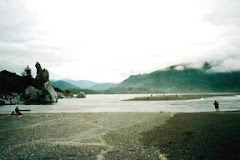
 Where River meets Sea

Reclamation could still help the salmon

There is debate among fisheries biologists about whether artificial, short duration pulse flows as proposed by Reclamation are a good idea. Fishermen report that past pulse flows on the Trinity (aka South Fork Klamath) side of the basin – while they entice the fish to run up river – subsequently confused them when Reclamation turned off the spigot at Trinity Dam and the higher flows ended.

Some biologists are concerned that many of the adult salmon attracted upriver by increased flows will turn left at Weitchpec and enter a Klamath River above the Trinity confluence which is running low and is polluted to the extreme. KlamBlog shares the fear that augmented flows in the Trinity could help create a large die-off of adult salmon in the Klamath River above Weitchpec. 

The threat of a fish kill above Weitchpec has motivated some activists to call for more water to be released from Iron Gate Dam in order to ameliorate poor flow and water quality conditions in the Klamath River below iron Gate Dam. Others feel that increasing Klamath River flows could be detrimental to salmon because water from the Upper Klamath River Basin is of such poor quality. Increased Klamath flows could be particularly detrimental to salmon if they are not sustained or are "ramped up" too rapidly.

As one fisheries biologist quipped recently, temporarily augmenting river flows to prevent a repeat of the 2002 fish kill in the Lower Klamath River is, in essence, an “uncontrolled experiment”.

Post Adjudication

Not withstanding the experimental nature of artificially augmenting Klamath and Trinity flows in August, and the questionable legality of augmenting Trinity River flows this year, the Bureau of Reclamation possess the legal right and ability to augment flows on the Klamath River (North Fork Klamath) side of the basin in a sustained manner The State of Oregon recently completed the Klamath Basin Adjudication and granted to the federal government the top priority among consumptive uses of water.1 Under Oregon law, those water rights can be temporarily or permanently shifted from irrigation and used to augment Klamath River flows or to provide water to Klamath Wildlife Refuges.

Furthermore, Reclamation failed to meet minimum Klamath River flows the agency stated in their 2013OperationsPlan they would provide. Reclamation failed to meet minimum Klamath flows during 11 days in April, 29 days in May and 12 days in June. During the same period, the Agency also dewatered Lower Klamath and Tule Lake National Wildlife Refuges in order to provide more water to the irrigation interests it serves.

At the same time Reclamation was shorting the Klamath River and providing San Joaquin farmers who rely on Trinity River water with only 20% of their full, contracted water allocation, the same Agency provided Klamath Project Irrigators with about 80% of their full, contracted water allocation. This is yet one more reason KlamBlog refers to the Klamath Basin's pampered federal irrigators as the Irrigation Elite.

Sunday, August 4, 2013

Just Published : Luke Ruediger's "The Siskiyou Crest: Hikes, History & Ecology"


KlamBlog readers will remember Luke Ruediger. Back in November of last year we published Luke's account of the 2011 Goff Fire on the Klamath National Forest. Luke did what KlamBlog editor Felice Pace has long advocated - he studied, recorded and reported on the natural history of the fire, including the suppression effort mounted by the US Forest Service. 

Luke documented the beneficial manner in which the natural Goff Fire burned within the Kangaroo Roadless Area. He - along with Felice - also documented the destructive nature of fire suppression actions undertaken by firefighters under the supervision of Klamath National Forest managers. These managers failed to mandate MIST - Minimum Impact Suppression Tactics - within the Kangaroo Roadless Area. As a result, destructive and ineffective firelines and burnouts were constructed along Fort Goff and Portuguese Creeks necessarily damaging water quality and salmon refugia. We also received reports but were unable to confirm that firefighters used bulldozers inside the roadless area. 

Subsequently, Luke came to the conclusion that it was likely a firefighter lit burn-out - not the natural wildfire - which escaped fire lines and threatened homes in the Seiad Valley. In a letter, Felice asked Klamath National Forest Supervisor Patricia Grantham - who approved all suppression actions - to respond if she had knowledge that the fire which threatened the Seiad Community was not lit by firefighters. Ms. Grantham did not respond to the letter.    

Now Luke has written and self-published a guide to an area which he may know better than any other living person. Luke Ruediger grew up hiking the Siskiyou Crest and as an adult he has continued to roam over and study the area. Below is Luke's own description of his self-published book on the Crest. You can find information on how to order a copy at the end of the description

KlamBlog believes that Luke Ruediger is an example of the new values, new insights and new leadership which are just beginning to emerge in Klamath Country. We look forward to what Luke and his generation will accomplish as they replace the region's aging leaders.       
                    ______________________


The Siskiyou Crest: Hikes, History 

& Ecology 
 
 
A new hiking and natural history guide for the Siskiyou Crest
By Luke Ruediger

An invaluable and detailed tool for exploring this little known, yet wonderfully diverse region, The Siskiyou Crest: Hikes, History, & Ecology explores the sunlit oak woodlands, ancient old-growth forests, scrubby slopes of chaparral, pristine mountain lakes, and the rugged flower-filled ridgelines and meadows of the Siskiyou Crest.


The author examines the region’s wild character, unique biological diversity, unusual botany, fire ecology, natural history, and human history within each hike description and introductory chapter.

The book outlines the region’s many threats and potential solutions to these threats including the proposed designation of the Siskiyou Crest National Monument.

Take this book along on any Siskiyou Crest adventure!


  • 76 Hikes  

  • 19 Roadless Areas

  • The Red Buttes Wilderness Area

  • The Siskiyou Wilderness Area

  • The entire proposed Siskiyou Crest National Monument


Order this book online at:

Tuesday, July 30, 2013

Dead adult salmon showing up in the Klamath


One would not know it from media reports, but those who live, work or recreate along the Klamath and Scott Rivers are reporting that “floaters” - which are dead juvenile salmon and steelhead - are becoming a regular sight along these two rivers. KlamBlog suspects the same is true on the Shasta and other streams with large agricultural diversions. While most irrigation ditches are still running full, these streams are already dry or are running low and hot.

Due mostly to a vast increase in groundwater pumping since 1977 
the Scott River now goes dry even in some non-drought years

Of even more concern is that, in the last day or two, Yurok fishermen have reported to the Yurok Tribe and to neighbors that they've observed a couple of dead adult salmon and numerous dead juvenile salmon in the Lower Klamath River near Blue Creek. Rising in wilderness, Blue Creek forms a major cold water refugia for salmonids and other fish where that cold stream enters the Klamath. If dead adult salmon are turning up there, it may indicate that cold water refugia on which Klamath Salmon rely to stay alive in a lethal river have become less effective. 

Along the Scott River, dead juvenile salmon and steelhead have been regularly seen by swimmers and others since mid-July. KlamBlog editor Felice Pace has personally observed dead juvenile steelhead recently in the Scott River at Jones Beach.

Where's the information?

The Califoirnia Department of Fish and Wildlife, the North Coast Water Board, US Fish and Wildlife Service, the Yurok and Karuk Tribes and others collaborate on monitoring fish disease levels and mortality on the Klamath River. CDFW's “season summary” report on 2013 out-migrant salmon monitoring was issued on July 23rd. However, this report is not available on the CDFW website or on any other website as far as KlamBlog can determine. The latest fish health update from the US Fish and Wildlife Service was issued on July 22nd. This too is apparently not available on line.

KlamBlog has obtained a copy of the most recent fish health report. It includes the finding that by late June up to 100% of fish in the reach between the Salmon and Trinity River and 50% of the fish examined in the Klamath Estuary were found to be diseased. The scientists doing this work say this level of disease is not abnormal for the Klamath at this time of year; they're keeping the disease alert level at “yellow” rather than “red” because, they say, widespread fish mortality has not yet been detected.

Weekly prevalence of Ceratomyxa shasta infection in juvenile Fall Chinook salmon 
captured in the Salmon to Trinity River reach on the Klamath River, June-July 2013
 
The current situation then is that scientists are producing information on the state of fish disease and mortality in the Klamath and its tributaries but those responsible for getting that information out to the public are not doing their jobs. Why is information collected with taxpayer money which the public wants and needs not getting out? Where are the fish health and mortality updates and weekly press releases to inform the public? 

KlamBlog believes it is the responsibility of the California Department of Fish & Wildlife to keep the public informed about disease and fish mortality on the Klamath River. During times of drought, the agency should issue weekly media updates on Klamath and tributary fish and water conditions. CDFW insists that it is the top fish manager in California waters; therefore, they are the ones who should be getting out the information.

The KBRA effect

KlamBlog suspects that the lack of public information on the People's Klamath River and the People's Klamath Salmon is a product of the culture of secrecy which has developed in the Klamath River Basin as a consequence of the KBRA Dam Deal and the KBRA Water Deal. Having bought into low Klamath River flows, those tribe's and fishing organizations which signed the KBRA will face embarrassment and criticism if the public learns that fish are dying for lack of water while federal irrigators continue to get full – or nearly full – deliveries. Many of those who would once have been screaming bloody murder over this are now meekly staying in their seats in the backroom – or, even worse, shilling for the Bureau of Reclamation - as more and more salmon die in the Klamath River.

It is sad that the past defenders of Klamath Salmon have been compromised and co-opted into silence at a time when Klamath Salmon need their help so critically.

Meanwhile on the Trinity

A major controversy is developing over plans by the US Bureau of Reclamation to release additional water from behind Trinity Dam down the Trinity and Lower Klamath in hopes of preventing another massive adult salmon die-off like what occurred in the Lower River in 2002. However, Reclamation plans no complementary increase in Klamath River flows. This has some salmon advocates concerned that Klamath River salmon will be lured upriver by the increased flows only to encounter lethal conditions in the Klamath River above the confluence with the Trinity River. Severely depressed Shasta and Scott River Salmon stocks could be placed at even greater risk if that is what takes place.

Meanwhile, rich and power agricultural interests in the San Joaquin Valley have filed a letter declaring their intent to sue to prevent Reclamation from releasing more water down the Trinity River. They want that water diverted to the Sacramento River instead so that it will come to them as irrigation water. Ironically, while blocking the increased flow would hurt Trinity River origin salmon, it may be better for Klamath, Salmon, Scott and Shasta River Salmon. That is because – if flows remain low – the large run of salmon will remain longer in the nearby ocean and Klamath estuary until flows naturally increase with the coming of fall. Naturally higher flows and lower temperature in the fall would mean less chance of adult salmon mortality. 

Huge pumps suck Trinity and Sacramento River water from the  
Sacramento-San Joaquin Delta and send it south to San Joaquin growers

Of course a better solution would be for Reclamation to allow more water to flow down BOTH the Trinity and Klamath Rivers. As the holder of high priority water rights, the federal government could - and should - make that decision. Any irrigation deficit within the Klamath Project can be made up by pumping more groundwater. Federal and state taxpayers have already provided these irrigators with plenty of wells and pumps.   

Allowing the Salmon to delay their spawning run, however, would inconvenience tribal commercial fishing interests and in-river sports fishermen and guides who count on catching these fish in Klamath and Trinity Rivers beginning now.

Sunday, July 7, 2013

The Wyden Hearing Message: How will Klamath River Basin leaders respond?


Thanks to Oregon Senator Ron Wyden, Klamath water issues finally received a hearing in Congress. Sadly, however, the hearing produced little that is new....at least not from the witnesses. Leaders from state, tribal and county government, federal and private irrigation and environmental groups repeated the same tired old arguments once again. Plenty of “press” resulted but little that could be termed real “news”.

What was new came not from the testimony (which you can read on line) but rather from Senator Wyden. For one thing, the Senator announced that irrigation interests served by the US Bureau of Reclamation would receive cheap, federal power courtesy of the Bonneville Power Administration. This will provide federal irrigation interests with a competitive advantage over private irrigators in the Upper Basin, Shasta and Scott Valleys. It is another example of why we call these federally-served irrigation interests the Basin's Irrigation Elite

Massively Inefficient: three of dozens of energy guzzling pumps used by Klamath 
Project Irrigators to move water and wastewater to and from subsided fields

Senator Wyden appears to reject the KBRA as a viable solution. In his remarks opening the senate hearing (also available online) he noted that the KBRAis making a big difference for the on-project irrigators. But the fact is hundreds of farm households and citizens have been left behind.

Wyden backed that up at another point: 
          ...all parties should have a chance to have input before the committee advances any legislation and I state that whether or not they have been for the previous agreements or have differing views.

The Senator noted that “the KBRA and essentially what has been agreed to at this point is simply unaffordable in the current federal budget environment.”

When Senator Wyden announced that the Irrigation Elite and Reclamation had obtained access to inexpensive federal power, he offered support for similar lower power rates for private irrigators. By this he meant irrigators above Upper Klamath Lake; no one has suggested that irrigators in the Shasta and Scott Valleys also receive Bonneville power. And the Senator committed tositting downwithbasin interests to find a long term solution that reflects both the anticipated water supply in the years to comeand theeconomic issuesfaced byfamily farmers. 

Senator Wyden concluded his opening remarks with a commitment:
           I want everybody to understand that we are going to stay at this, we are going to stay at it until we find a solution this time.