Thursday, September 1, 2011

Whales, Worms and Water - A month on the Klamath

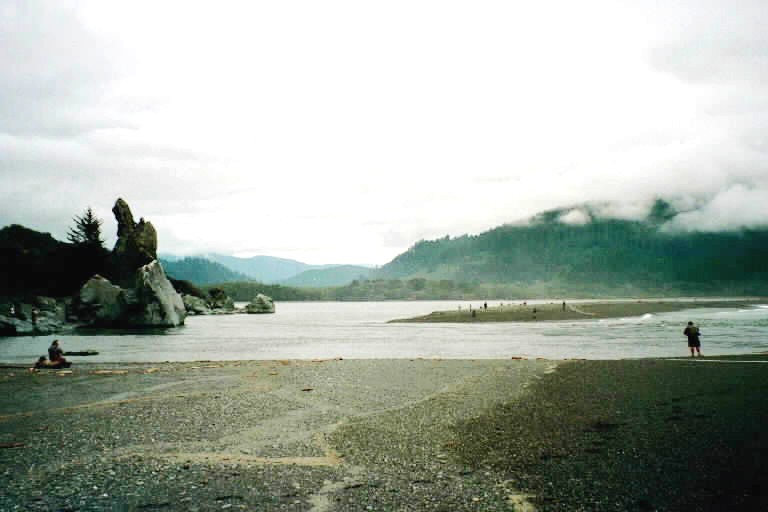
For much of August a female Gray Whale nicknamed Momma took up residence in the Lower Klamath River. Staying in the vicinity of the Highway 101 bridge, the behemoth became such a tourist attraction that CalTrans had to put up signs warning of pedestrians on the two lane bridge. The bridge provides limited space for a single pedestrian, much less the crowds that sought a glimpse of the creature.  The whale has now passed away and, after being studied by scientists, has been respectfully buried on land.

"Momma" the gray whale in the Lower Klamath River

As reported in the Two Rivers Tribune, Indigenous natives consider such unusual behavior to be a warning to humans. Yurok ceremonial leader Chris Peters summarized the traditional view:
           This is perhaps a message of something still more foreboding yet to come. A signpost in time—when the ocean is polluted with human waste and the sonar sounds of US Navy testing invade the oceans,” he said. “As I think about the spiritual significance of such a large mammal—a very close relative—choosing to give her life in the Klamath River, I can only assume that it’s a sign—a very important sign that we all need to take note of and prepare for change to come.

While it would be tempting to interpret the message as a judgment on how the Klamath River is being managed, no one has apparently made that claim. That’s a sign the respect Momma received in life continues after her passing.

Worms and Water

Flows in the lower Klamath River remain more substantial than those we’ve seen in many summers. Thanks go to the Hoopa Tribe which fought the long fight for more water in the Trinity and to the weather gods which favored us with the best Klamath Mountains snowpack in decades.  The higher flows are expected to decrease the prevalence of fish disease in the Klamath River. Epidemic levels of disease related to poor water quality in the Klamath, Shasta and Scott Rivers have been responsible for an annual, mass die-off of juvenile Coho and Chinook salmon and Steelhead on their way to the ocean. This year’s higher flows are expected to reduce the worm-like stage of one of the parasitic diseases which annually destroy young Klamath Salmon en route to the ocean. For more on Klamath fish diseases and what is being done to combat them see this link.  

Meanwhile PacifiCorp has used the KHSA’s dispute resolution process to negotiate a deal with the National Marine Fisheries Service (NMFS) and the Bureau of Reclamation (Reclamation) which will allow the company and Reclamation to cut Klamath River flows below “minimum” flows set out in the 2010 Biological Opinion. The decision to further lower minimum flows - which were already cut in the 2010 Biological Opinion in order to conform to the KBRA Water Deal - is hidden in the body of letters exchanged by PacifiCorp, Reclamation and MNFS.

In its February 4th letter to NMFS and Interior/Reclamation PacifiCorp states:
           Reclamation will request written concurrence from NMFS that compliance with minimum flows specified in MNFS’ 2010 Biological Opinion for Reclamation’s operation of the Klamath Irrigation Project may be accomplished with actual flows falling within a reasonable range above or below the target minimum flow. The reasonable range and target minimum flow will be established by NMFS after further consultation among PacifiCorp, Reclamation and NMFS.

On February 7th NMFS responded to PacifiCorp. The wording is (intentionally?) confusing but the effect is to authorize lower flows than those contained in the 2010 Biological Opinion:
           NMFS anticipates some deviation from the proposed ramp down rates may occur due to PacifiCorp’s operational constraints…

While the letters quoted above have been published, the actual setting of “target minimum flow” was deferred. That critical step has likely now been completed in closed door meetings. This is the sort of mischief which occurs when backroom dealing becomes the norm as it has on the Klamath under the Dam and Water Deals.

KlamBlog challenges NMFS leaders to publish on the Klamath Restoration website a comparison of the new target minimum flow they’ve set with PacifiCorp and Reclamation, the target minimum flow from the 2010 Bi-Op and the target minimum flow from the 2002 Bi-Op.  We believe that comparison will make it clear that promoters of the KHSA and KBRA continue to use backroom dealing to cut the amount of water available for Klamath River Salmon.

A different species of water

The Two Rivers Tribune recently reported that Oregon Senator Jeff Markley is prepared to “carry water” for PacifiCorp and other Klamath Deal “parties” in order to implement the Klamath Dam and Water Deals. Markley has circulated draft legislation to Deal “parties” - those who have signed on to the KHSA and KBRA) for comment. Because they deviate from normal government procedures, the Dam Deal and key aspects of the Water Deal cannot be implemented without federal legislation.

It is widely believed that legislation to implement the Deals will face a tough road in the House of Representatives where California Congressman Tom McClintock has signaled strong opposition. McClintock was recently able to get a provision blocking funding for studies related to the Deals through the House. However, his funding prohibition did not survive in the final legislation.

Recently Oregon Wild circulated a letter to Senator Markley which dealt exclusively with the impact of the Deals on the complex of Klamath Wildlife Refuges.  That has fueled speculation that the Oregon group is willing to accept other Water Deal provisions if it can get what it wants for the refuges. 

Fall on Tule Lake NWR. 
The complex of Klamath Refuges hosts 80% of Pacific Flyway birds during migration.
Many environmental groups oppose commercial farming on the Klamath Refuges

Oregon Wild’s action is one indication that environmental groups which oppose aspects of the Dam and Water Deals have not coalesced into a coalition or offered coherent, comprehensive alternatives to the Dam and Water Deals. Those groups include Oregon Wild and Water Watch in Oregon, the Northcoast Environmental Center, EPIC and Friends of the River in California and the Sierra Club in both states.

Less Water

As this KlamBlog is being published the last patches of snow are melting in the mountains above the Scott River Valley. When those patches are gone, flows in the national forest streams feeding Scott River will drop dramatically. There will not be sufficient flow to maintain hundreds of stream diversions, keep groundwater levels high and still provide wet habitat for young Coho, Chinook and Steelhead living in Scott River and major tributaries in the Scott River Valley.

It remains to be seen whether Scott River itself – which this year is full of young salmon – will go dry this fall or whether there will be sufficient flow when adult Chinook spawners begin arriving in late September. But the fact that some streams have already dried up does not bode well for salmon and steelhead.

Meanwhile the California Department of Fish and Game (CDFG) was in Scott Valley a week ago asking irrigators to voluntarily put water into Scott Valley streams to keep Coho, Chinook and Steelhead from dying as the streams go dry. The meeting provided an opportunity for more government bashing by Tea Party folks. The actual irrigators in attendance appeared unwilling to lend a helping hand to Coho. As KlamBlog has pointed out, CDFG would not need to beg for water if it were willing to enforce provisions of the California Constitution which provide fish with a first right to streamflow sufficient to keep them “in good condition”.

Tuesday, August 23, 2011

Siskiyou County is a special place


Browbeating the feds

Fresh from having browbeaten two national forest supervisors into presumed submission, the Siskiyou County Board of Supervisors set their sights on the National Marine Fisheries Service last week.  Backed by right wing consultants and middle-level timber company executives, a dominant faction on the board- professes to believe that the federal government must “co-ordinate” its policies with county policy as defined by the supervisors.  They appear to believe that in the case of policy conflicts, county policy must prevail.


Flood Irrigation, Scott River Valley, October 30th, 2007
By law irrigation is supposed to end on October 15th
Out-of-season irrigation is a common, illegal practice in the Scott River Valley

In the case of the National Marine Fisheries Service what these supervisors want is likely something akin to the “special” treatment they got in the California State Coho Recovery Plan. In a move which infuriated other stakeholders, the California Fish and Game Commission designated Siskiyou County’s Scott and Shasta Valley a recovery “Pilot Project” where the “voluntary approach” to compliance with California environmental laws favored by farmers and ranchers will be followed.  So far that “voluntary approach” has facilitated the progressive dewatering of these valleys, hidden “take” at diversions via bogus “fish rescue” and tried to justify it all with special valley-wide  ”take” permits which California courts quickly threw out because they don’t follow the very laws state officials swear to uphold.

California state government’s rancher-dictated approach to salmon recovery in the Scott and Shasta River Valleys amounts to using taxpayer money to lease the water fish need to survive. Now that taxpayer dollars have become scarce, the Department of Fish & Game (CDFG) has resorted to begging for a little water. KlamBlog was on hand last week in Fort Jones to witness DFG’s pleas on behalf of the fish.

Many salmon advocates oppose paying for the water they say fish have a right to under California law.  The plain language of Fish and Game Code 5937 appears to back them up. 

As for the national forests, the supervisors’ strategy appears to be to keep the pressure on federal decision makers to tow the county line on forest transportation decisions and logging projects while working for legislation that would give the county direct management control. The legislative scheme – along with other strategies – is detailed in the recently-adopted Siskiyou County National Forest Accountability Project – which was cooked up with the help of a couple of timber companies. Supervisor Michael Kobseff will lead an effort to enlist Senator Diane Feinstein and Congressman Wally Herger to sponsor legislation giving the county management control of the entire Klamath and portions of the Shasta National Forests.   
 
A special history

When it comes to county chutzpa there are few counties in the USA which can compare with the Klamath River Basin’s Siskiyou County. Usually counties concern themselves with issues like crime and whether to let that new box store in. But most Siskiyou County politicians appear to be obsessed with what other government are doing and with the idea that they have the right to dictate policy to those other governments. In essence, Siskiyou County attempts to stand the government pyramid you learned about in civics class on its head. As they see it, they are closest to the people and so should tell other governments what to do.

The Siskiyou County obsession with control goes back to the days just before and after statehood. When Federal Agent Redick McKee tried to provide the Indigenous Shasta inhabitants with a treaty and a reservation stretching from Scott Valley to the Oregon border, white miners, ranchers and politicians protested loudly and whittled it down to a fraction that size. When McKee left the area they immediately began demanding that the treaties not be ratified by the Senate. As in other places in California, a campaign was organized to “exterminate” the Indians. These white citizens figured that if there were no Indians there could not be a reservation. While some looked the other way or even protested, the public campaign to "exterminate" all remaining Indigenous inhabitants dominated and nearly succeeded.

Most California counties have moved beyond the sort of racism that led to campaigns of extermination; some have undertaken truth and reconciliation processes. In Humboldt County, for example, the renaming and return of the island where a bloody massacre of native women and children occurred was not too long ago the occasion for healing and reconciliation. But Siskiyou County seems stuck in a sordid past which is officially denied but which haunts county politics and social relations.  Hostility toward the two tribes based in the county – the Karuk Tribe and the Quartz Valley Indian Reservation – and toward Indigenous natives generally is never far from the surface in this rural county and sometimes finds open expression.               

Appeasement

Over the past 15 years, Siskiyou County boards have adopted several documents mandating federal and state coordination with county policies. And while it would be tempting to dismiss the documents as rhetorical political statements without force of law, they would not be replicated if they had not proven effective at some level.  The success in getting the “special” treatment they believe they deserve via California’s Coho “Pilot Project” has apparently encouraged the Siskiyou Supervisors to pursue the same sort of approach in other venues.  

A long line of Siskiyou County supervisors – not to mention school superintendents, DAs and sheriffs - have been rewarded for demanding that other governments and their officials tow the local line. KlamBlog previously documented how California CDFG officials kowtow to county policy on fish, water and stream access issues.  Appeasing such bullying simply encourages more demands.

The dominant faction among Siskiyou County Supervisors (Ed Valenzuela who represents the Mt. Shasta-Dunsmuir area does not appear to approve) have now set their sights on the federal recovery plan for Southern Oregon Northern California Coast Coho (SONCC Coho).  The SONCC Coho “evolutionary significant unit” or ESU spans two states and all or parts of three counties in Oregon and five counties in California. The Siskiyou Supervisors’ faction has not indicated how it intends to "coordinate" with these other governments.

Will Siskiyou County again be recognized as “special” in the federal Coho Recovery Plan?

Stay tuned.

Saturday, August 13, 2011

Cal Fish and Game goes to the Scott River Valley...with its hand out

Officials from the California Department of Fish and Game have scheduled a meeting next Tuesday evening at Fort Jones in Siskiyou County. At that meeting CDFG officials will ask Scott River Valley irrigators to please let some water past the dams and diversions they operate so that young Coho and Chinook salmon and Steelhead trout will not be stranded and die. Even in this wet year - one of the best water years on record - irrigators who divert streams and also pump groundwater from numerous wells near the river are collectively dewatering key Scott River tributaries. In average and dry years, Chinook and Coho salmon have trouble accessing any of their spawning grounds in or above the 30 mile long agricultural Scott River Valley.

The dewatered Scott River near Fort Jones, October 2, 2009
 
The irony is that the State of California has the right – clearly stated in its constitution - to flows below those dams and diversions that are adequate for fish.  As a matter of policy, however, CDFG managers have decided that the State’s right to keep rivers alive should not be exercised in the Scott River Valley….or in the Shasta River Valley….or in just about any other stream in California.  The decision to allow irrigators to dewater streams below dams and diversions is arguably an abrogation of CDFG managers’ sworn duty. It is also one key reason Klamath River Coho – and so many other salmon stocks in California - remain on the brink of extinction.

But don’t take KlamBlog's word for it. Read the Fish and Game Code section 5937 which is part of California’s Constitution. And then read the SF Chronicle article at this link which is also reprinted below. The Chronicle report by veteran reporters Glen Martin and Tom Steinstra details CDFG’s (mis)management policy on the Scott and Shasta Rivers. These two Klamath River tributaries should be the production breadbasket for Klamath River Salmon, but they have instead become salmon basket cases. Diversion of salmon restoration funds to benefit irrigators and willful refusal of government officials to champion the species they are sworn to protect are key reasons the Scott River and its salmon are dying.

Twenty-eight years ago when the famous Mono Lake Decision issued from California’s Supreme Court, salmon advocates thought the future would be different. Armed with a decision strongly affirming the ancient Public Trust Doctrine, salmon folks expected the California Department of Fish & Game to use the Mono Lake precedent to keep irrigation interests from dewatering our salmon streams.

We have been bitterly disappointed.  Instead of using the Public Trust Doctrine to protect salmon streams, the California Department of Fish & Game is standing by while irrigation interests dewater our streams and destroy the salmon. The best this corrupt department can muster is to politely request that irrigators let a little water pass the dams and diversions so that the streams don’t completely dry up.

It is unlikely Scott River Valley irrigators will budge; why should they when CDFG has for so long been a paper tiger threatening regulatory action but never taking a violation there to court? Even when an irrigator killed hundreds of thousands of salmon and steelhead a few years back by dewatering a section of the Upper Scott River, CDFG did not prosecute.

Bogus restoration project on the Scott River. This is where hundreds of thousands of fish died a few years back when the Farmer's Irrigation Ditch was turned on dewatering the River. 

There is, however, new leadership in Sacramento. In the governor’s office; down the street at the Resources Agency and across the street at the Department of Fish & Game there are new leaders who are to this point untainted by the deep-rooted malfeasance which has infected CDFG management for far too long.

Governor Brown, Resource Secretary Laird and CDFG Director McCamman have an opportunity to make a new start. They should begin with the Klamath. For the sake of Klamath River Salmon, they should sweep the stables clean - providing new leadership and new policy direction at the Northern Regional Office.

If they are going to survive, Klamath River Salmon need CDFG managers who will enforce the laws which should protect the Scott and Shasta Rivers from dewatering.  Politely asking irrigators who for years have been dewatering rivers to please change course will not work; when laws are being systematically and intentionally disregarded, law enforcement is the only effective way forward. 

An Irrigation Ditch in the Scott River Valley on December 25, 2009. Several Scott River ranchers run diversion ditches full year around. The practice is illegal but CDFG and State Watermasters refuse to end the practice .                                                     
                               ______________________


Young fish die as water laws go unenforced: Ranchers' cooperation threatened

SF Chronicle
Glen Martin, Tom Stienstra, Chronicle Staff Writers
Friday, June 22, 2001

Irrigation by ranchers is decimating salmon and steelhead populations on California's second biggest river system, and Department of Fish and Game officials acknowledge they are not implementing a tough state law that could stop the diversions.

Ranchers have diverted most of the flow of the Scott and Shasta Rivers in Siskiyou County to irrigate alfalfa fields and pastures, leaving thousands of young salmon and steelhead without enough water and facing imminent death.

State game wardens generally are disposed to citing the diverters under Fish and Game Code 5937, which requires dam owners to maintain water in state streambeds sufficient to keep fish healthy.

But agency officials say they are being told not to cite offenders out of concern that cooperative restoration projects between the state and ranchers on the Scott and Shasta Rivers would end instantly if the law were enforced.

The controversy points out difficulties with cooperative programs between government agencies and private parties.

Though such agreements can help resolve thorny environmental problems, they may also inhibit agencies from cracking down on private sector partners.

Warden Renie Cleland said he was told to back off from citing ranchers on the Scott and Shasta rivers.

"This has gone all the way to Sacramento," said Cleland. "It's extremely politically sensitive. I was told to take no enforcement action on it. These fish are dying. We've got five or six thousand steelhead trout dead on the Scott, and (dead juvenile steelhead) everywhere on the Shasta."

MAJOR KLAMATH TRIBUTARIES

The Scott and Shasta are major tributaries of the Klamath River, which is second only to the Sacramento River in its dimensions and the number of fish it supports.

The Klamath and its tributaries once supported hundreds of thousands of chinook salmon, coho salmon and steelhead trout. Their numbers began declining in the mid-20th century from dams, agricultural irrigation and timber harvesting. By the mid-1980s, only a few thousand fish were left -- mostly on the Scott and Shasta.

During the past decade, efforts to screen agricultural pump intakes, reduce soil erosion, restore riparian forests and transport fish trapped in "dewatered" streambeds have bolstered the fish populations somewhat.

WATER RIGHTS FROM THE 1930S

But conflict between environmentalists and ranchers over diversions has simmered for years. Ranchers exercising water rights adjudicated in the 1930s typically lower the rivers through irrigation during the summer.

This year, a severe local drought has greatly increased the degree of the problem. The Scott has been sucked dry, and the Shasta reduced to a trickle at its juncture with the Klamath.

Temperatures in the river have reached or exceeded the level considered lethal for salmon species, which favor cold water. Thousands of fish have died, and thousands of others face imminent death, making the pumping a clear violation of Code 5937.

"Everything has died," said Fish and Game Captain Chuck Konvalin of the Scott River. "The system has been dried up."

Konvalin, who heads a team of wardens who operate in the north state, says their superiors are reigning them in.

"This thing is out of whack," said Konvalin. "I get my orders."

Gary Stacey, a fisheries program director for Fish and Game who oversees projects in the Klamath area, said enforcing Code 5937 would "slam the door" on meaningful restoration programs along the Scott and Shasta, which cost $25 million a year.

"All our current programs depend on landowner cooperation," he said. "That would all stop immediately if we pulled the trigger. And the process involved in filing and prosecuting a case like this could take years -- years the fish don't have.

"By taking strong law enforcement action, we could simply be assuring that the (fish) populations would wink out."

COOPERATIVE EFFORTS

Ranchers confirm they would scrap all cooperative ventures with the state if they were cited by game wardens, and say they are guaranteed diversion rights by court rulings made decades ago.

Gary Black, who diverts Scott River water to irrigate alfalfa and wheat on his 240-acre farm, said ranchers would respond to voluntary incentives to improve fish populations but would resist government fiat.

"We're looking for win-win situations," said Black, who helps direct a local resource conservation district that promotes fish-friendly agricultural methods. "I've worked with more than half the farmers in the Scott Valley.

Everyone is willing to do their part for fishery protection -- the question becomes how far is too far."

Still, "flows remain the number one issue, and this is a good time to sit down and talk," Black said. "That will work better around here than getting out the citation book."

©2001 San Francisco Chronicle

Monday, August 1, 2011

Klamath Propaganda: Who do you believe?

Across the US, July and August are notoriously slow months for news. So too on the Klamath – with the exception of the whale visit (What could that mama be trying to tell us?), there is a dearth of Klamath River news.

Behind the scenes, of course, those who have “access” to federal and state “decision makers” are busy jockeying for position. They want scientific views which they favor to hold sway in the EIS/EIR being prepared to “inform” a decision on whether the Klamath Dam and Water Deals are in “the public interest” and will restore salmon runs. The Public Draft EIS/EIR is scheduled for release in September. 


The EIS/EIR is intended to inform a decision by the Secretary of Interior on the fate of both the Klamath Dam Deal (the KBRA) and the Klamath Water Deal (or KBRA) . KlamBlog is taking the opportunity presented by the lull to reflect on the war of words being waged in the region’s opinion pages concerning these Deals.  Depending on who you choose to believe, the Deals are either the best thing to come along since penicillin or a threat to local “custom and culture” which will flood riverfront property and destroy the local economy.  All sides claim their science is “good” and the other guy’s science is hogwash.  This post is an opportunity to learn who is writing the commentaries and the claims they are making.

But first a word about our decision to label these commentaries and opinions “propaganda”: The word “propaganda” is popularly taken to mean deliberate falsification in order to influence public opinion. The dictionary definition , however, recognizes that propagandists may use either facts or falsehoods - or a combination of both - as suites their purpose. Even when no falsehoods are stated, most propaganda presents facts selectively. This is sometimes referred to as “lying by omission”. What distinguishes propaganda from other communication is intent - propagandists seek to influence those receiving the information to act or believe a certain way.    


Immediately below is a list of those who have published recent Klamath commentaries or editorials. Their commentaries/editorials follow in that order.

     John Spencer is a retired lawman and an avid fisherman. For many years John lived on the Shasta River where he angled for Steelhead and worried over poor water quality and low flows. He now lives in Anderson, California and writes a fishing column for the Redding Record Searchlight.

     Mark Baird is a Scott River Valley hobby rancher and a leader of the Siskiyou County Tea Party. He recently purchased a radio station in Yreka.

     Craig Tucker runs the Karuk Tribe’s Klamath River Campaign. Tucker previously worked for Friends of the River and Green Corp.

     Ani Kame'enui is Washington, D.C., legislative coordinator for Oregon Wild. Alexandra Borack is conservation advocate for Friends of the River.

     Dean Brockbank is vice president and general counsel for PacifiCorp Energy – owner of the Klamath Hydroelectric Project. PacifiCorp is owned by Warren Buffett’s Berkshire Hathaway Investment Company.

     John Menke is a retired range professor who with his wife owns and operates a ranch in the Scott River Valley. The Menkes have adopted the practice of running their irrigation ditches full year around even though their irrigation rights are limited to only a portion of the year.

     Patrick Higgins is a Northcoast fisheries biologist who has been working on Klamath science and restoration since 1986. These days he represents the Resighini Rancheria on Klamath River issues.

While it probably does not qualify as “propaganda” we should mention a scholarly article published recently in the Washington Journal of Environmental Law & Policy. Dewatering Trust Responsibilities: The New Klamath River Hydroelectric and Restoration Agreements is by Thomas Schlosser – an attorney who represents the Hoopa Tribe. "The article argues that the agreements prioritize the water rights of non-Indian irrigation districts and utility customers over first-in-time Indian water and fishing rights.”

KlamBlog wants to know your opinion on the veracity of these individuals and the worth of their opinions. Read the seven commentaries-editorials reprinted below and then leave a comment.

Please remember to be honest and respectful.