Sunday, October 6, 2013

Greed trumps science - TID's plan to mine groundwater in the Klamath River Basin

Adoption of a Groundwater Management Plan by the Tulelake Irrigation District (TID) this past April has not been reported in the press...but it should have been. The Plan covers the California portion of the Lower Lost River Basin within the Bureau of Reclamation's Klamath Project. In spite of evidence that the deep groundwater aquifer is being depleted, the Tulelake Irrigation District's plan is to
          "enable the District, individual landowners, and their regional neighbors to continue use of local groundwater as a supplemental water supply during years of surface water shortages."

Tulelake Irrigation District (TID) is controlled by fewer than 10 growers who, by virtual of their wealth and political power, dominate both the District and the Klamath Water Users Association. These growers have been successful for over a decade in preventing their "neighbors" from selling legal and contractual rights to Klamath River water so that the rights can be retired and demand for water diverted from the Klamath River can be brought into line with demand for that water.

One reason TID's dominant growers oppose retiring water rights and contracts is the money the District has pocketed in recent years selling groundwater. TID uses deep wells and pumps provided by California at taxpayer expense during a drought emergency to sell water to "neighbors" and to the Bureau of Reclamation.


One of nine deep wells and pumps gifted to Tulelake  
Irrigation District in 2001 by the State of California 

Reclamation buys well water from TID when demand for irrigation water exceeds the supply available from the Klamath River. Purchasing and retiring water rights and contracts within Reclamation's Klamath Irrigation Project would mean Reclamation would not have to buy groundwater from TID. As is usually the case in the Klamath River Basin, understanding how the money flows is key to understanding Klamath water issues.

Tulelake Irrigation District's Plan for Groundwater

TID's Groundwater Management Plan acknowledges that groundwater extraction since 2002 has lowered the deep aquifer and attributes the decline to below average precipitation. The Plan does not, however, use the model developed by the US Geological Survey for predicting the impact of groundwater extraction rates on future groundwater supplies. Instead TID's plan calls for continuing to use groundwater to meet any deficit in surface water supplied by Reclamation over irrigation water demand.

Located in the bed of the former Tule Lake, the Tulelake Irrigation District  
includes the highest value agricultural soils within the Klamath Project including 
18,000 acres of controversial, commercially farmed national wildlife refuge lands   

Since 2002, groundwater pumping and government payments in exchange for not irrigating have occurred whenever surface water supply from the Klamath River has not been sufficient to meet full Klamath Project irrigation demand. In other words, and in contrast to private irrigators, salmon, wildlife refuges and all others who depend on Klamath River water, federal irrigators have been made whole one way or another when there has been a shortage of Klamath River irrigation water. 

A know nothing plan

Thursday, September 19, 2013

Klamath Disaster Roulette: Waterfowl and Eagles are the latest casualties


While media attention focuses obsessively on impending disasters, Klamath reality is that there is always another crisis or two simmering below the surface of the Klamath River Basin's waters. Often the next crisis bubbles up even as the previous one is winding down.

This summer of yet another drought year (they seem to be coming more often these days), media and public attention was focused on the large number of salmon expected to return to the Klamath River. The Hoopa and Yurok Tribes, in particular, called attention to low flows and poor water quality – conditions which, when combined with a large salmon run, led to a dramatic die-off of adult salmon in the Lower Klamath River in 2002. 

Each tribe called for the Bureau of Reclamation to release more water from Trinity Dam into the South Fork of the Klamath (aka the Trinity River) in order to stave off a fish kill. Others called for complementary releases from Iron Gate Dam so that adult salmon entering the North Fork of the Klamath (aka the Mainstem above Weitchpec) would not be enticed to ascend the River only to die in the low flow and poor water quality conditions found in the North Fork (Mainstem).

    Agriculture in the Upper Basin, Shasta Valley and Scott Valley is the
#1 source of Klamath River nutrient and temperature pollution

The Bureau of Reclamation responded to calls for Trinity Dam releases but delivered a silent rebuke to those calling for increased flows from Iron Gate Dam. Increasing flows from Iron Gate would have required a reduction in irrigation water delivery within Reclamation's Klamath Project. Armed with a new biological opinion granting the Agency “flexibility” to cut flows below biological opinion “minimums” (sic), Reclamation, which has always served the interests of federal irrigators above all else, simply ignored the request for release of more Klamath River Water downstream to avoid a fish kill.

Then came a spate of arson and lightning fires on the Mid-Klamath; soon smoke was blanketing much of the Basin. The fires caused road, trail and wilderness closures and evacuation orders; the fire's smoke also lowered the temperature of Mainstem (North Fork) water a full ten degrees! The smoke blocked so much solar radiation in some watersheds that streamflow was observed to increase – although the rise was not apparent in river and major tributary hydrographs.

By the end of August, rain and sustained higher humidity had tamed the fires, lifting the blanket of smoke. By then, however, shorter days and cooler air temperature assured that the worst water quality conditions would not return. While the salmon run is still not over and water quality is still not good, the threat of an adult fish kill has receded. Through a combination of nature's beneficence and serendipity, the Klamath River Basin had avoided another disaster...just barely.

The next crisis

Even as attention was focused on the feared fish kill, another crisis was developing. Relying on an Interior Department Solicitor's Opinion from the 1990s, Reclamation officials were dewatering the oldest and most important of the Klamath River Basin's eight national wildlife refuges.

Dewatered permanent marsh on Lower Klamath NWR, July 2013 

Thursday, August 15, 2013

Klamath Water Woes


On Wednesday a federal judge in Fresno issued a temporary injunction halting the planned release of additional water from Trinity Dam to the Trinity and Lower Klamath Rivers. The Bureau of Reclamation had scheduled the pulse flow in order “to prevent a potentially serious fish die off impacting salmon populations entering the Klamath River estuary.”

An injunction can only be issued if the judge believes those seeking the injunction are likely to prevail in the subject litigation. In his order granting a temporary injunction Judge Lawrence O'Neill indicated that:
          The Trinity River Record of Decision (“TRROD”), which, among other things, sets forth the volume of water to be released to provide in-stream flows below Lewiston Dam on the Trinity River
in various water year types, clearly indicates that while “the schedule for releasing water on a daily basis ...may be adjusted...the annual flow volumes...may not be changed.”

The Judge has promised to make a final decision on the requested injunction on August 16th after parties and intervenors submit replies to their respective original briefs. It appears likely he will issue a full, ongoing injunction at that time.

Meanwhile, native fishermen tell KlamBlog that, while some some adult salmon have already ascended the Klamath River, most of the expected large run come into the estuary but then – sensing that conditions are bad for making the run - go back to the ocean.

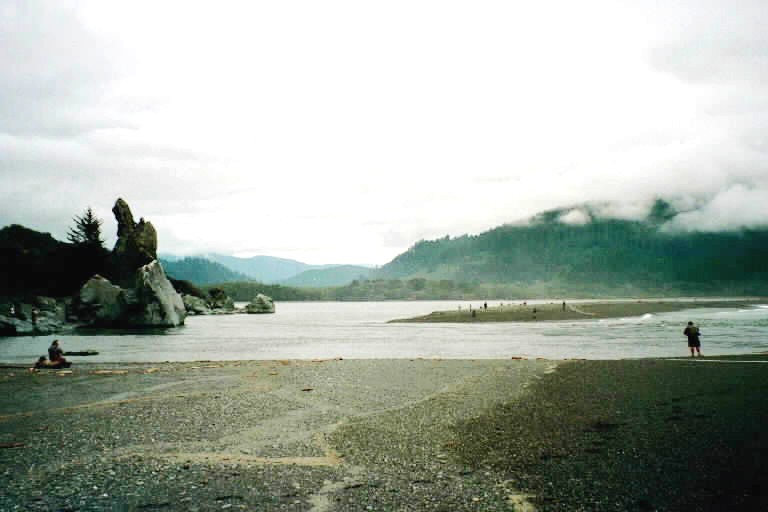
 Where River meets Sea

Reclamation could still help the salmon

There is debate among fisheries biologists about whether artificial, short duration pulse flows as proposed by Reclamation are a good idea. Fishermen report that past pulse flows on the Trinity (aka South Fork Klamath) side of the basin – while they entice the fish to run up river – subsequently confused them when Reclamation turned off the spigot at Trinity Dam and the higher flows ended.

Some biologists are concerned that many of the adult salmon attracted upriver by increased flows will turn left at Weitchpec and enter a Klamath River above the Trinity confluence which is running low and is polluted to the extreme. KlamBlog shares the fear that augmented flows in the Trinity could help create a large die-off of adult salmon in the Klamath River above Weitchpec. 

The threat of a fish kill above Weitchpec has motivated some activists to call for more water to be released from Iron Gate Dam in order to ameliorate poor flow and water quality conditions in the Klamath River below iron Gate Dam. Others feel that increasing Klamath River flows could be detrimental to salmon because water from the Upper Klamath River Basin is of such poor quality. Increased Klamath flows could be particularly detrimental to salmon if they are not sustained or are "ramped up" too rapidly.

As one fisheries biologist quipped recently, temporarily augmenting river flows to prevent a repeat of the 2002 fish kill in the Lower Klamath River is, in essence, an “uncontrolled experiment”.

Post Adjudication

Not withstanding the experimental nature of artificially augmenting Klamath and Trinity flows in August, and the questionable legality of augmenting Trinity River flows this year, the Bureau of Reclamation possess the legal right and ability to augment flows on the Klamath River (North Fork Klamath) side of the basin in a sustained manner The State of Oregon recently completed the Klamath Basin Adjudication and granted to the federal government the top priority among consumptive uses of water.1 Under Oregon law, those water rights can be temporarily or permanently shifted from irrigation and used to augment Klamath River flows or to provide water to Klamath Wildlife Refuges.

Furthermore, Reclamation failed to meet minimum Klamath River flows the agency stated in their 2013OperationsPlan they would provide. Reclamation failed to meet minimum Klamath flows during 11 days in April, 29 days in May and 12 days in June. During the same period, the Agency also dewatered Lower Klamath and Tule Lake National Wildlife Refuges in order to provide more water to the irrigation interests it serves.

At the same time Reclamation was shorting the Klamath River and providing San Joaquin farmers who rely on Trinity River water with only 20% of their full, contracted water allocation, the same Agency provided Klamath Project Irrigators with about 80% of their full, contracted water allocation. This is yet one more reason KlamBlog refers to the Klamath Basin's pampered federal irrigators as the Irrigation Elite.

Sunday, August 4, 2013

Just Published : Luke Ruediger's "The Siskiyou Crest: Hikes, History & Ecology"


KlamBlog readers will remember Luke Ruediger. Back in November of last year we published Luke's account of the 2011 Goff Fire on the Klamath National Forest. Luke did what KlamBlog editor Felice Pace has long advocated - he studied, recorded and reported on the natural history of the fire, including the suppression effort mounted by the US Forest Service. 

Luke documented the beneficial manner in which the natural Goff Fire burned within the Kangaroo Roadless Area. He - along with Felice - also documented the destructive nature of fire suppression actions undertaken by firefighters under the supervision of Klamath National Forest managers. These managers failed to mandate MIST - Minimum Impact Suppression Tactics - within the Kangaroo Roadless Area. As a result, destructive and ineffective firelines and burnouts were constructed along Fort Goff and Portuguese Creeks necessarily damaging water quality and salmon refugia. We also received reports but were unable to confirm that firefighters used bulldozers inside the roadless area. 

Subsequently, Luke came to the conclusion that it was likely a firefighter lit burn-out - not the natural wildfire - which escaped fire lines and threatened homes in the Seiad Valley. In a letter, Felice asked Klamath National Forest Supervisor Patricia Grantham - who approved all suppression actions - to respond if she had knowledge that the fire which threatened the Seiad Community was not lit by firefighters. Ms. Grantham did not respond to the letter.    

Now Luke has written and self-published a guide to an area which he may know better than any other living person. Luke Ruediger grew up hiking the Siskiyou Crest and as an adult he has continued to roam over and study the area. Below is Luke's own description of his self-published book on the Crest. You can find information on how to order a copy at the end of the description. 

KlamBlog believes that Luke Ruediger is an example of the new values, new insights and new leadership which are just beginning to emerge in Klamath Country. We look forward to what Luke and his generation will accomplish as they replace the region's aging leaders.       
                    ______________________


The Siskiyou Crest: Hikes, History 

& Ecology 
 
 
A new hiking and natural history guide for the Siskiyou Crest
By Luke Ruediger

An invaluable and detailed tool for exploring this little known, yet wonderfully diverse region, The Siskiyou Crest: Hikes, History, & Ecology explores the sunlit oak woodlands, ancient old-growth forests, scrubby slopes of chaparral, pristine mountain lakes, and the rugged flower-filled ridgelines and meadows of the Siskiyou Crest.


The author examines the region’s wild character, unique biological diversity, unusual botany, fire ecology, natural history, and human history within each hike description and introductory chapter.

The book outlines the region’s many threats and potential solutions to these threats including the proposed designation of the Siskiyou Crest National Monument.

Take this book along on any Siskiyou Crest adventure!


  • 76 Hikes  

  • 19 Roadless Areas

  • The Red Buttes Wilderness Area

  • The Siskiyou Wilderness Area

  • The entire proposed Siskiyou Crest National Monument


Order this book online at: