donnybrook: an uproar, a free-for-all, a brawl. Derived from the Irish town of the same name famous for brawling.
cabal:A clique (often secret) that seeks power usually through intrigue)
The long-promised “Draft 12” of the proposed Klamath Basin Restoration Agreement (KBRA) has been completed…or has it? While those in control refuse to release Draft 12, the Klamath Basin Crisis (KBC) website published a copy recently. It is labeled "KBRA Latest version of Draft 11" and dated 5/6/09.Whether this is Draft 12 or 11b, our hats are off to Jacqui Krizo of KBC for liberating a document which powerful interests do not want the people of the KlamathRiver Basin to see – at least not yet!
This latest version of the KBRA is even longer and more convoluted than Draft 11 with lots of complex legal language. But one thing is clear: it does not follow through on the promise made by Glen Spain – who represents the Pacific Coast Federation of Fishermens’ Associations (PCFFA) in the negotiations – that the Klamath Settlement Group (KSG) would address the serious issues which have been raised with Draft 11 since it was release 16 months ago.
Spain is one of the dominant personalities in the secretive collection of organizations and agencies which calls itself the Klamath Settlement Group (KSG). Along with Troy Fletcher representing the Yurok Tribe, Chuck Bonham representing Trout Unlimited and Paul Simmons who represents the small group of wealthy irrigators who have long dominated UpperKlamathBasin politics (aka Klamath Water Users Association (KWUA), Spain forms a leadership cabal which preaches consensus but consults, meets and makes important decisions without consulting other KSG members.
The cabal recently revealed its true temperament. After over two years of frustrated effort to make the KBRA a document it could support, The Northcoast Environmental Center (NEC) decided that all its suggestions were going to be ignored. Consequently the organization declared its intent to leave the KBRA but remain in negotiations with PacifiCorp and others over the fate of that corporation’s five Klamath River dams.
The cabal, however, has always insisted that the two agreements are inseparable. This, of course, is a silly notion. It is not necessary, for example, to provide a small group of rich irrigators with primacy in water allocation and many millions in anti-competitive subsidies in order for a dam agreement to work. In fact the opposite is true – the mass of special interest subsidies and benefits which the cabal seeks to tag onto a dam deal makes actually removing the dams much more difficult and uncertain.
Working through the KSG’s “facilitator” – a man personally chosen for the task by the Bush Administration’s Interior Department – the cabal informed the NEC that it would be banned from continuing dam negotiations. But the NEC representative, Greg King, cried foul; the NEC insisted that the entire group follow its declared consensus process.
This is not the first time the cabal has sought to control the KSG agenda and process.For example, certain non-scientists (Glen Spain among them) were allowed to participate in the much heralded “science summit” while others - including Petey Brucker of the Klamath Forest Alliance - sought but were denied access. Other KSG members have complained privately about the cabal’s control of the KSG process. But, except for the NEC, none have apparently risen to challenge cabal control.
Cabal members lost no time in attacking the NEC once it decided to withdraw from the Klamath Water Deal (KBRA). For example, Glen Spain recently claimed that the NEC’s press release explaining why it rejected the water deal is “riddled with outright errors and misstatements.”
The cabal wants the agreement they crafted and controlled behind closed doors to become the center of the Klamath debate. But KlamBlog predicts this tactic will fail. There are real alternatives to the cabal’s vision for the Klamath’s future. For example, soon after release of Draft 11 KlamBlog published an analysis of the KBRA which identified “strengths, weaknesses and alternatives” to its major provisions. You can refer back to that analysis by scrolling down to the January 18, 2008 KlamBlog entry. Or you can use this link.
We will soon see other alternatives articulated which will figure prominently as the Klamath debate shifts to Congress.
The NEC says it stands by its explanation of why it was forced to abandon negotiations. Fortunately citizens can now decide for themselves. Klamath Basin Crisis has published the May 6, 2009 draft of the KBRA.You can compare it with the original Draft 11, dated January 15, 2008, on the KBC site. Decide for yourself whether Glen Spain’s claim - that major issues with Draft 11 raised by diverse interests and individuals have been adequately addressed - is accurate or false.
It appears clear that we are heading for a donnybrook in Congress over the future of the KlamathRiver Basin. On one side will be the Irrigation Elite (aka Klamath Water Users Association), Trout Unlimited, The Yurok, Karuk and Klamath Tribes and others; one the other side will be the NorthcoastEnvironmentalCenter, Hoopa Tribe, Oregon Wild, Water Watch of Oregon and others.
Where PCFFA will come down remains to be seen. If Glen Spain has his way they will join with the Irrigation Elite and others. But that route is not supported by some prominent fishermen and could lead to a deep rupture between PCFFA and the very environmental organizations which have been the salmon fishermen’s staunchest allies in the battle to restore Pacific Salmon. How the PCFFA Board will vote remains in doubt.
As this is being written Klamath River residents are arriving in Omaha. It would be a safe bet that they are heading for the annual meeting of Berkshire Hathaway - the company controlled by Warren Buffet which owns the Klamath River's mainstem dams. It remains to be seen whether they will appear with Mr. Buffet or - as in the past - on the outside looking in.
Meanwhile, the conservation group International Rivers, a leading socially responsible investment firm and an international labor rights organizationare also crashing Mr. Buffet's party. Backed by a shareholder petition, the trio want Berkshire Hathaway to prepare annual sustainability reports telling shareholders about social and environmental conditions and risks at the investment company's world-wide holdings. We've given you the link to each of the groups' PR on the petition; it's interesting to read how each frames the issues.
In a press release International Rivers executive director, Patrick McCully, referred to the Klamath River Dams. Here's what he said: "Klamath River dams now operated by Berkshire Hathaway’s PacifiCorp subsidiary have been linked to toxic water conditions that produced the largest single salmon die-off in U.S. history. Now PacifiCorp has promised to pay up to $200 million for the dams’ removal, because government studies show this would be cheaper than making the dams compliant with environmental laws. When your company has dams that are so harmful that it's cheaper to dismantle them than get them re-licensed, shouldn’t shareholders know that?”
Meanwhile Fox Business News is reporting that tickets to the Berkshire-Hathaway Shareholders Meeting are selling cheap on e-bay. They were going for up to $250 but the company flooded the market. Was Mr. Buffet just upset with seeing the tickets sold on e-bay or is he hoping lots of people and press will show up in Omaha? The latter would be consistent with announcing a dam removal deal and adopting the sustainability report proposal.
KlamBlog could not confirm a river rumor that Siskiyou County Supervisors Cook and Armstrong had obtained tickets on e-bay and were en route to Omaha!
The word is out among Klamath cognoscenti that a final deal to remove four of PacifiCorp’s five Klamath River dams is imminent. Barring last minute snags, look for a Dam Deal to be announced soon – possibly before the end of March.
Meanwhile, Klamath Riverkeeper is once again soliciting donations in order to send Klamath River residents to Omaha for the Berkshire Hathaway shareholder meeting. Berkshire Hathaway and Warren Buffett, the company’s chief shareholder, own PacifiCorp.
Those going to Omaha say that they are “cautiously optimistic regarding PacifiCorp’s ongoing negotiations with local communities on a dam removal plan” but that they “want the corporation to know we are anxious to see a final binding agreement that removes dams and protects our water quality.”
Klamath Riverkeeper has adopted a strong position on a Klamath River dam deal. According to their web site, the group is adamant that a final dam removal agreement must:
Comply with the mainstem Klamath TMDL and preserve the integrity and enforceability of all water laws and regulations.
Preserve and respect the roles and authorities of water quality regulators.
Limit immunity to the act of dam removal.
Commit to locate funding for dam removal independent of a bond that would build a peripheral canal or any new dams.
Eliminate or drastically improve the secretarial finding clauses that give the federal government veto power over dam removal in 2012.
Increase certainty of dam removal by eliminating rights of withdrawal or qualifying them with written consequences for exercising those rights.
Last year dam removal advocates did not receive a warm reception from Berkshire Hathaway. But with a “final” deal immanent, KlamBlog would not be surprised to see last year’s protesters sharing the podium with Mr. Buffett when a Deal is announced in Omaha this spring. If that happens, Buffett and PacifiCorp will have completed a transformation from “corporate profiteer” to “Klamath Hero” – at least in well spun media reports.
Those media reports will be a sure indication whether the Deal is good for PacifiCorp and its shareholders. But they will likely not let the public know whether or not the Deal will be good on balance for the Klamath River – including whether it meets Klamath Riverkeeper’s criteria as described on the group’s web site and reported above.
KlamBlog remains skeptical on that score but we will wait to see what is proposed and hope for the best. If the “Agreement in Principle” that preceded it is any indication, however, the final Deal will be a special interest Christmas Tree loaded with taxpayers-financed payoffs for PacifiCorp, the Klamath’s Irrigation Elite and certain tribal bureaucracies.
Whatever happens in Omaha and whatever the final Deal includes, however, one thing is sure: announcement of a final Deal will not really be “final”. If public financing, water management, new subsidies, exemption from regulation and liability forgiveness for PacifiCorp and the Irrigation Elite are included - as appears likely - federal and state legislation will be needed and that will be a new ball game that can not be hidden from public scrutiny.
In our March 26th post KlamBlog announced that a powerful new player – the Industrial Customers of Northwest Utilities (ICNU) had entered the Klamath fray. ICNU represents big industrial power users including the Aluminum and Internet Industries. On the Klamath the association is likely focused on preventing legislation which would give the Irrigation Elite access to cheap Bonneville Power which the group’s industrial members now control. KlamBlog expects ICNU to be active when and if Dam and Water Deal legislation is introduced into Congress.
And don’t count out those members of the environmental and fishing community who do not support the Water Deal and oppose a sweetheart deal for PacifiCorp. There are a large number of such organizations in the First Congressional District where Congressman Mike Thompson is seen as critical to passage of Klamath legislation. Mr. Thompson will be under strong pressure from his constituents to not sponsor Klamath Legislation which puts a select group of powerful irrigators first in line for Klamath River Water over salmon and wildlife refuges.
For the above reasons announcement of a “final” Dam Deal will not, in fact, be final. Whatever is in that Deal there will be months and years - and many twists of fate - before the issue of PacifiCorp’s Klamath River Dams – and the controversial Water Deal which some interests hope can ride the dam removal wave – are indeed “final”.
__________________________
FISH AND GAME COMMISSION REJECTS HATE PETITION AIMED AT KARUK FISHING RIGHTS
Long simmering just under the surface, antagonism between the Siskiyou County Board of Supervisors and the Karuk Tribe has now boiled over. The current bone of contention is recreational mining on the Klamath River with the Karuk Tribe joining Klamath Riverkeeper in legal and administrative challenges and the Siskiyou Supervisors strongly opposing that move.
In retaliation for the petition and related lawsuit to limit and better regulate mining, the New 49ers (a recreational mining organization based in Happy Camp), the Siskiyou County Grange and others filed a petition with the Fish & Game Commission asking for removal of Karuk fishing rights at Katimin – the center of the Karuk World at Somes Bar. Sponsors of the petition asked the Siskiyou Supervisors to join in – a position strongly supported by Supervisor Marcia Armstrong who represents the Klamath River Area where both the Tribe and the New 49ers are based. While they oppose regulation of recreational mining, however, the other four supervisors would not go along with Armstrong and SiskiyouCountydid not join the attack on Karuk fishing.
Recently the California Fish & Game Commission heard and rejected the punitive petition.
In a related move which for the most part slipped under the media radar, the State of California recently threatened to cancel SiskiyouCounty’s administration of the Surface Mining and Reclamation Act (SMRA).Prompted by citizen complaints, the state found that SiskiyouCounty had not adequately administered mine reclamation – collecting performance bonds but not verifying that reclamation work had actually taken place after mineral extraction ended. Consequently, the state issued a 45-day notice of its intent to take over the reclamation program.
Looking at a loss of control and a corresponding loss of revenue, the county swallowed its sovereignty rhetoric and began doing the job it was obligated to do all along.
_________________________________
WHOREPRESENTSUPPERBASIN “OFF-PROJECT” IRRIGATORS?
There is a struggle going on in the UpperKlamathRiver Basin concerning who has a right to represent the interests of the “other” group of irrigators – those who do not obtain water via the federal Klamath Project operated by the US Bureau of Reclamation. KlamBlog readers will recall that we believe these non-federal irrigators would get a raw deal under the proposed Klamath Basin Restoration Agreement – what we call the Water Deal.
Of course these folks getting a raw deal compared to those who get federal irrigation water would be nothing new in the KlamathBasin. Here as elsewhere in the West those who have the good fortune to be part of federal irrigation projects have always been granted generous subsidies and other benefits which give them a competitive advantage compared to private irrigators. That is why federal project irrigators are generally better off than farmers and ranchers who do not get federal irrigation water. And that is one of the reasons KlamBlog calls these federal project irrigators the Irrigation Elite.
Most “Off- Project” irrigators seem to agree that the Water Deal is not in their interest. A small group of them, however, apparently think otherwise. It is that group which was recently granted membership in the elite and secretive Klamath Settlement Group. As a result the new group garnered lots of press. But “Off Project” irrigators who oppose the Water Deal are not taking the latest attempt to sideline and co-opt their interests lying down. Here is a letter about the situation written by Tom Mallams, President of the Klamath Off-Project Water Users Association, which was recently published in the Capital Press – an agricultural weekly covering California, Oregon, Washington and Idaho ~
'New' groups join Klamath talks?
Tom Mallams
Thursday, April 16, 2009
Once again the corrupt process overpowers logic, common sense and equitable participation. A small non-representative group being added to the Klamath Settlement Group is another example of how corrupt the dam removal and Klamath Basin Restoration Group process continues to be.
Upper Klamath Water Users Association was added in the so-called consensus-driven meeting even with the opposition of at least three of the groups. Their addition to the main group is just another "rubber stamp" of the federal government, tribal and environmentalist-driven group.
I guess consensus doesn't always mean consensus in this flawed process. It is like being sort of pregnant - you are or you are not. You can't have it both ways.
We have been promised that this process would always be a consensus-driven group. At the same time "another" formal request was made to add one or two truly representative irrigation groups in the upper basin. The Sprague River Water Users and/or Resource Conservancy, which represents a very substantial group of irrigators comprising approximately 125,000 irrigated acres. This request was turned down again and instead the small group representing approximately 2,000 irrigated acres was added to the group.
The obvious intention is to exclude any group that is not in complete agreement, to force the public, without due process, into dam removal, a tribal land gift and the so-called "promise" of water guarantee for the Klamath Project, under the guise of "saving the river."
There is still no credible science that states dam removal will even help the river or support fish survival if the dams are removed. There is equal logic that concludes that dam removal would actually worsen conditions with no sustained late-season flows. Actual dam removal costs are shown by two federal government studies to be in the billions of dollars. Fish ladders and structure upgrades certainly seem to be the best option at a cost estimated to be approximately $350 million.
We are still committed to a basin-wide settlement, but it has to be equitable and it is not even close to that as it is written today. This is evidenced by more participants in the Klamath Settlement Group formally dropping out of further talks, because of similar concerns we have been raising.
Our numerous attempts to introduce beneficial amendments in the Klamath Basin Restoration Agreement to address Off-Project Water Users' concerns is being portrayed as a roadblock by some. We are still trying to work with the settlement process, in spite of continually being excluded and ignored in our requests for changes in the agreement.
Tom Mallams, President, Klamath Off-Project Water Users Association, Beatty, Ore.
First announced in February, it is now a certainty that the onset of water delivery to irrigators in the federal Klamath Project will be delayed.
Typically the irrigation season begins in the upper Klamath River Basin on April 1st. This year, however, the onset of irrigation had to be delayed in order to meet the Upper Klamath Lake water level required for endangered Kuptu and Tsuam (sucker species) and Klamath River flows required for threatened Coho Salmon pursuant to the federal Endangered Species Act.
If this were 2001 we would be hearing loud calls for protests, civil disobedience and “reform” of the ESA – back then the idea of fish having a water priority which trumps irrigation was anathema to the Klamath Water Users Association (KWUA) and its supporters.
So why are there no calls for protest now? Where is Ric Costales – initiator of the Klamath Bucket Brigade – when his organizing skills are apparently again needed to defend people from the ravages of the ESA?
KlamBlog thinks that KWUA is keeping the lid on cries, calls and protests because it knows that would make the possibility of the Water Deal it has negotiated with the Klamath Tribes,Karuk Tribe, Yurok Tribe, Trout Unlimited, American Rivers and a few other organizations even less likely to achieve the federal legislation needed to make the Deal - and its massive subsidies for Klamath Project irrigators - a reality.
As KlamBlog has pointed out previously (see, for example, our 1/18/08 post), the Water Deal – also known as the Klamath Basin Restoration Agreement or KBRA – favors those irrigators who receive water via the federal Klamath Project. Along with other subsidies, the KBRA would put those farmers first in line for water. Other farmers, fish managers and wildlife refuge managers would then have to buy water during drought years from these farmers or go without. That is one reason KlamBlog calls farmers within the Klamath Project the Irrigation Elite.
Putting the Irrigation Elite first in line for Klamath water can only be achieved via federal legislation. KWUA has apparently concluded that making a fuss about the ESA this year would hurt its chances of achieving that legislation. KlamBlog agrees. In the final analysis when principles do not “pencil out” they are quickly discarded in that circle.
But what would this drought year actually be like if the Water Deal were enshrined in legislation? Would the Fish & Wildlife Service have to pay the Irrigation Elite in order to achieve lake levels which Kuptu and Tsuam need to survive? Would the National Marine Fisheries Service be required to also buy water from the Irrigation Elite to meet Klamath River flows which most biologists tell us are essential to the survival of Coho Salmon? Would federal wildlife refuges managers have to go to the Irrigation Elite with hat (or money) in hand to provide for waterfowl and Bald Eagles? And how much would this cost taxpayers in a mildly doughty year?
Because it is turning out to be a “dry” – but not a “very dry” – year in the Klamath River Basin, this would be a good time to calculate what would happen during a mild drought if the Water Deal were enshrined in federal legislation. This would also be a good time to model what would have happened if this had turned out to be a severe drought year. How much money would the taxpayers have to pay the Irrigation Elite to keep Kuptu, Tsuam and Coho Salmon from extinction? How much would it cost the taxpayers to provide the water needed by waterfowl, Bald Eagles and the other wildlife on Klamath Basin refuges?
Don’t look for Water Deal’s promoters to perform this analysis. KlamBlog believes these boosters do not want the public and members of Congress to know the consequences if a select group of irrigators were legislatively granted the first-in-line water priority which they know – and the courts have affirmed - they can not achieve in any other way.
But perhaps we should not judge Water Deal promoters so harshly! Instead let’s call on them to put real analysis and hard data behind their public claims.
This then is a call and a challenge to the leaders of the Klamath Settlement Group - those who have dominated and lead negotiations resulting in the proposed Water Deal - to put up or shut up. Come now Trout Unlimited; it is time to stand up and put analysis behind your claims! Come on Yurok Tribe: are you up to the challenge? How about it KWUA? Why not show the public what would happen - and what it would cost - if the Deal you say is so good for fish, farms and refuges were in place this mildly doughty year?
And to those reporters, editors and media outlets covering Klamath issues: how about doing your duty by demanding that such an analysis be performed?
Deal makers all: KlamBlog and the public await your response!
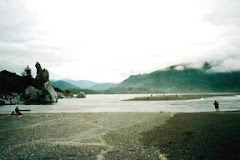
The Mouth, the Estuary and Oregos Guardian Spirit.
Welcome!
Welcome to KlamBlog. The purpose of this blog is to keep the People of the Klamath River Basin and others who are interested in the Basin informed about what is going on in the politics of the Basin - particularly the environmental politics - that is not making it into the mainstream media, is not available in "in-Basin" media or that is being spun by the media or others.
What you will get here, however, is a perspective, one which I hope will enlighten, inspire, inform, outrage, surprise and motivate you to take action. Sometimes you will also find an action alert, what others have written or press clips.
If you have something relevant you'd like to share - a comment or clip about the Klamath - send it to unofelice@gmail.com. All submissions will be considered for publication here; decisions are final and not subject to appeal.
Felice was born on January 10th 1947 into the working class Italian Community in South Philadelphia. He holds a BA in Economics from Yale U., a masters in Education from Montclair State University and a life-time California teaching credential. He has worked as a teacher/educator, laborer, Outward Bound instructor, social services administrator and as a consultant to Native American tribes. For fifteen years Felice worked for and led the Klamath Forest Alliance as Program Coordinator, Executive Director and Program Director. He remains part of the Alliance’s Core Group.
Felice lived in the Scott River Basin for 35 years; since 2002 he has resided near the mouth of the Klamath River at Klamath Glen.